

The Big Money Is Coming On-Chain: Why AI Crypto Infrastructure Could Define the Next Bull Market
Wall Street, tokenization, stablecoins, and AI-driven market infrastructure are reshaping crypto. Zyra Capital explores why the next bull market may be driven not just by price action, but by institutional liquidity, smarter execution systems, and the financial infrastructure moving on-chain.
At a Glance: Big institutional finance is no longer discussing on-chain markets as a distant experiment. In July 2026, DTCC successfully processed real production trades using tokenized DTC-held securities, following months of collaboration with more than 50 major financial firms. Combined with growing institutional crypto allocations, expanding stablecoin use, clearer tokenization frameworks, and AI-powered execution systems, the next crypto bull market could be driven as much by infrastructure as by speculation.
Executive Summary
The institutional shift toward on-chain finance is becoming operational. DTCC has converted traditionally held securities into tokens and used them in live production transactions involving Treasury/repo, equities, securities lending, collateral, and margin workflows. Its tokenization initiative has brought together banks, asset managers, custodians, exchanges, and market makers including BlackRock, Bank of America, Citadel Securities, Citi, Goldman Sachs, J.P. Morgan, Morgan Stanley, Nasdaq, NYSE, State Street, UBS, and Wells Fargo. This does not guarantee a crypto bull market, but it strengthens the case that tokenization, stablecoins, and digital-asset infrastructure are entering the core financial system.
Core Thesis
The next major crypto expansion may not begin with a meme coin or a single price breakout. It may begin when traditional securities, institutional liquidity, stablecoin settlement, and automated execution increasingly operate on shared digital infrastructure.
The Big Money Is Already Moving On-Chain
On July 15, 2026, the Depository Trust & Clearing Corporation announced that it had converted assets held at The Depository Trust Company into tokens and used them in real production trades. More than 30 traditional-finance and digital-market firms participated in the production initiative, which tested multiple asset classes and real-world workflows.
The transactions included collateral pledges, securities lending, U.S. Treasury and repo delivery-versus-payment trades, equity delivery-versus-payment trades, equity token transfers, and central-counterparty margin workflows. DTCC says the milestone prepares the market for its Tokenization Service launch planned for October 2026. DTCC's July 2026 production-tokenization announcement
DTCC is core post-trade infrastructure for global finance. Its May 2026 announcement said the service was being developed with feedback from more than 50 firms across traditional finance and digital assets. The participant list included major banks, asset managers, custodians, trading venues, market makers, and technology providers. DTCC's 50+ firm tokenization working group
Why This Could Be a Bigger Catalyst Than Another Short-Term Rally
Price rallies attract attention quickly, but infrastructure changes can reshape markets for years. Tokenized securities can potentially move between traditional and digital formats, access new liquidity pools, operate across different networks, and support new collateral and settlement workflows.
If adoption grows, the result may be a hybrid financial system in which traditional securities, crypto assets, stablecoins, tokenized funds, and institutional settlement rails increasingly interact. That could expand the number of venues, instruments, liquidity pools, and pricing relationships that sophisticated market infrastructure can monitor.
Regulatory Clarity Is Catching Up With the Technology
In January 2026, staff from three SEC divisions published a statement explaining common tokenized-security models. The statement distinguished between securities tokenized by issuers and securities tokenized by third parties, including custodial and synthetic structures. It also emphasized that placing a security on a crypto network does not remove the application of federal securities laws. SEC staff statement on tokenized securities
This is bullish for infrastructure because serious capital needs definable structures. Asset managers, custodians, compliance teams, and trading firms are more likely to invest in systems when ownership models, investor rights, custody arrangements, and regulatory responsibilities are easier to evaluate.
Institutional Investors Are Not Retreating
A 2026 survey conducted by Coinbase with the EY-Parthenon practice covered 351 institutional investors. Despite a difficult market environment, 73% said they planned to increase their crypto allocations during 2026, while 74% expected crypto prices to rise over the following 12 months. Two-thirds already held spot crypto ETFs or ETPs, and 81% preferred accessing spot crypto through a registered investment vehicle.
The same survey found that 86% of respondents were already using or actively exploring stablecoins for internal cash management, money movement, and related workflows. At the same time, 49% had increased their focus on risk management, liquidity, and position sizing. 2026 Coinbase and EY-Parthenon institutional survey
The bullish signal: institutions are not simply buying crypto and hoping. They are building regulated access, stablecoin workflows, custody systems, tokenized markets, liquidity controls, and execution infrastructure.
Why AI Crypto Infrastructure Could Define the Next Bull Market
As more financial assets move on-chain, markets may become more connected and more fragmented at the same time. A security could exist in traditional form, as an issuer-sponsored token, through a custodial representation, inside an ETF, and across multiple trading or settlement venues. Stablecoins can add another layer of liquidity and settlement choice.
That complexity creates a data and execution problem. Market participants need systems capable of normalizing prices, comparing liquidity, evaluating fees, monitoring venue health, managing rate limits, routing orders, confirming fills, and reconciling positions across different infrastructures.
AI can support this process by analyzing larger datasets and more venue states than manual workflows can reasonably monitor. But the real advantage comes from combining AI with execution engineering, hard risk limits, cybersecurity controls, and reliable reconciliation.
How Zyra Capital Users Could Potentially Benefit
For Zyra Capital users, the financial opportunity is not based on the claim that every tokenized asset or institutional announcement will generate profit. The opportunity is that a larger, more fragmented, and more liquid digital market may create more relationships for Zyra Capital's infrastructure to evaluate.
More venues can mean more pricing differences. More settlement rails can mean more timing and collateral differences. More institutional flow can mean larger liquidity events. More tokenized assets can mean a broader universe of instruments. These developments may expand the opportunity set for AI-assisted, market-neutral, and multi-venue strategies, provided that execution and risk controls are strong enough.
Why This Bull Market Could Look Different
Previous crypto cycles were often dominated by retail speculation and directional price momentum. The next cycle may still include both, but its foundation could be broader:
-
Tokenized securities: traditional assets operating on digital networks.
-
Stablecoin settlement: programmable cash-like instruments supporting 24/7 workflows.
-
Regulated access: ETFs, ETPs, custody structures, and compliant trading venues.
-
Institutional liquidity: banks, asset managers, market makers, and wealth platforms participating at scale.
-
AI execution: systems that analyze fragmented markets and manage complex order workflows.
Coinbase Institutional's 2026 outlook describes clearer regulation and accelerating institutional integration as forces deepening crypto's role in the core financial system. Its 2026 market guide also describes ETFs, options, futures, and other regulated products as part of a new phase in institutional crypto markets. Coinbase Institutional 2026 Crypto Market Outlook Coinbase Guide to Crypto Markets 2026
Stablecoins Could Become the Liquidity Layer
Stablecoins may play a central role because tokenized markets still need settlement assets. They can support faster transfers, cross-border movement, exchange liquidity, collateral workflows, and programmable payments. The Bank for International Settlements recognizes that stablecoins demonstrate some of tokenization's potential for faster and programmable payments, while also warning that current structures carry important financial-integrity and stability risks. BIS 2026 analysis of tokenization and stablecoins
For AI execution infrastructure, stablecoin growth matters because it can increase the number of active pairs, settlement routes, collateral choices, and cross-venue flows that need to be monitored. It can also create new counterparty and reserve risks, which means risk analysis becomes more important rather than less.
What Zyra Capital Is Built to Address
Zyra Capital's research and infrastructure focus aligns with this market transition. The platform's public content emphasizes AI model infrastructure, multi-exchange connectivity, execution routing, failure recovery, risk controls, custody awareness, and reconciliation.
That positioning matters because the next market cycle may reward platforms that can do more than identify a bullish trend. It may reward platforms capable of operating across fragmented liquidity, measuring execution conditions, and responding to a growing number of digital-market relationships.
What to Watch Next
The Risks Behind the Bullish Thesis
A bullish infrastructure thesis does not remove risk. Tokenized markets can remain illiquid. Stablecoin issuers can face reserve or redemption problems. Regulatory frameworks can become more restrictive. Institutional flows can reverse. AI models can fail. Exchanges, custody providers, networks, and APIs can experience outages or security incidents.
Users should therefore distinguish between a growing market opportunity and a guaranteed financial outcome. Zyra Capital's infrastructure may help evaluate and manage parts of this complexity, but it cannot eliminate market, liquidity, counterparty, execution, model, or technology risk.
Frequently Asked Questions
Is Wall Street really moving assets on-chain?
Yes. DTCC reported that DTC-held securities were converted into tokens and used in real production trades in July 2026. Its tokenization working group includes more than 50 firms from traditional finance and digital markets.
Does tokenization guarantee a new crypto bull market?
No. Tokenization strengthens the long-term infrastructure thesis, but crypto prices remain volatile and can decline even while adoption grows.
How could tokenization create trading opportunities?
Tokenized and traditional versions of assets may trade through different venues, liquidity pools, settlement systems, and operating hours. These differences can create pricing, liquidity, collateral, or timing dislocations, although they may not always be executable or profitable.
Why is AI important for on-chain markets?
AI can help process fragmented market data, compare venues, monitor liquidity, identify unusual flows, evaluate routes, and support risk-aware automation. It still requires reliable execution infrastructure and human-defined controls.
Can Zyra Capital users profit from institutional tokenization?
Institutional tokenization may expand the market opportunity set available to Zyra Capital's infrastructure, but no profit is guaranteed. Outcomes depend on available spreads, liquidity, fees, execution quality, counterparty conditions, and risk controls.
Related Zyra Capital Research
-
The Quiet Bull Case for Crypto: Regulation, Stablecoins, Tokenization, and AI Infrastructure
-
AI Agents vs Trading Bots: Why Crypto Trading's Next Era Depends on Execution Infrastructure
-
The Execution Gap: How Zyra Capital Connects AI Trading Signals to 50+ Crypto Exchanges
-
Is AI Crypto Trading Safe? What Investors Should Know About Infrastructure, Risk, and Execution
The Bottom Line
The big money is not merely watching on-chain markets anymore. DTCC is processing tokenized securities in production, major institutions are collaborating on new digital-market infrastructure, and institutional investors continue to expand their use of crypto products and stablecoins. If this transition continues, AI-powered market data, risk controls, and execution infrastructure could become one of the defining competitive layers of the next crypto bull market.
Sources and References
-
DTCC: U.S. Trades Successfully Processed Using DTC-Tokenized Assets
-
2026 EY-Parthenon and Coinbase Institutional Investor Survey
-
BIS: Anchoring Trust in Money - Innovation Beyond Stablecoins
Disclaimer: This content is for informational purposes only and does not constitute financial, investment, legal, tax, regulatory, or trading advice. Digital asset markets involve substantial risk, including possible loss of principal or total loss. Tokenization, institutional adoption, stablecoin growth, AI systems, market infrastructure, survey expectations, or historical examples do not guarantee future market performance or user profitability. Users should review Zyra Capital's official risk disclosure and seek independent professional advice where appropriate.
Mehr aus Market Analysis

AI Arbitrage in a Volatile Market: Why Speed Matters When Prices Move
When crypto markets turn volatile, price gaps can open and close in seconds. Zyra Capital explains why AI arbitrage, execution speed, and infrastructure matter when Bitcoin and digital assets move fast.

Is AI Crypto Trading Safe? What Investors Should Know About Infrastructure, Risk, and Execution
AI crypto trading is not risk-free. This Zyra Capital guide explains how investors should evaluate infrastructure, risk controls, execution quality, transparency, and platform limitations before trusting AI-powered crypto trading systems.
How AI Captures Arbitrage Opportunities in 100 Milliseconds: Inside Zyra Capital's Multi-Exchange Strategy
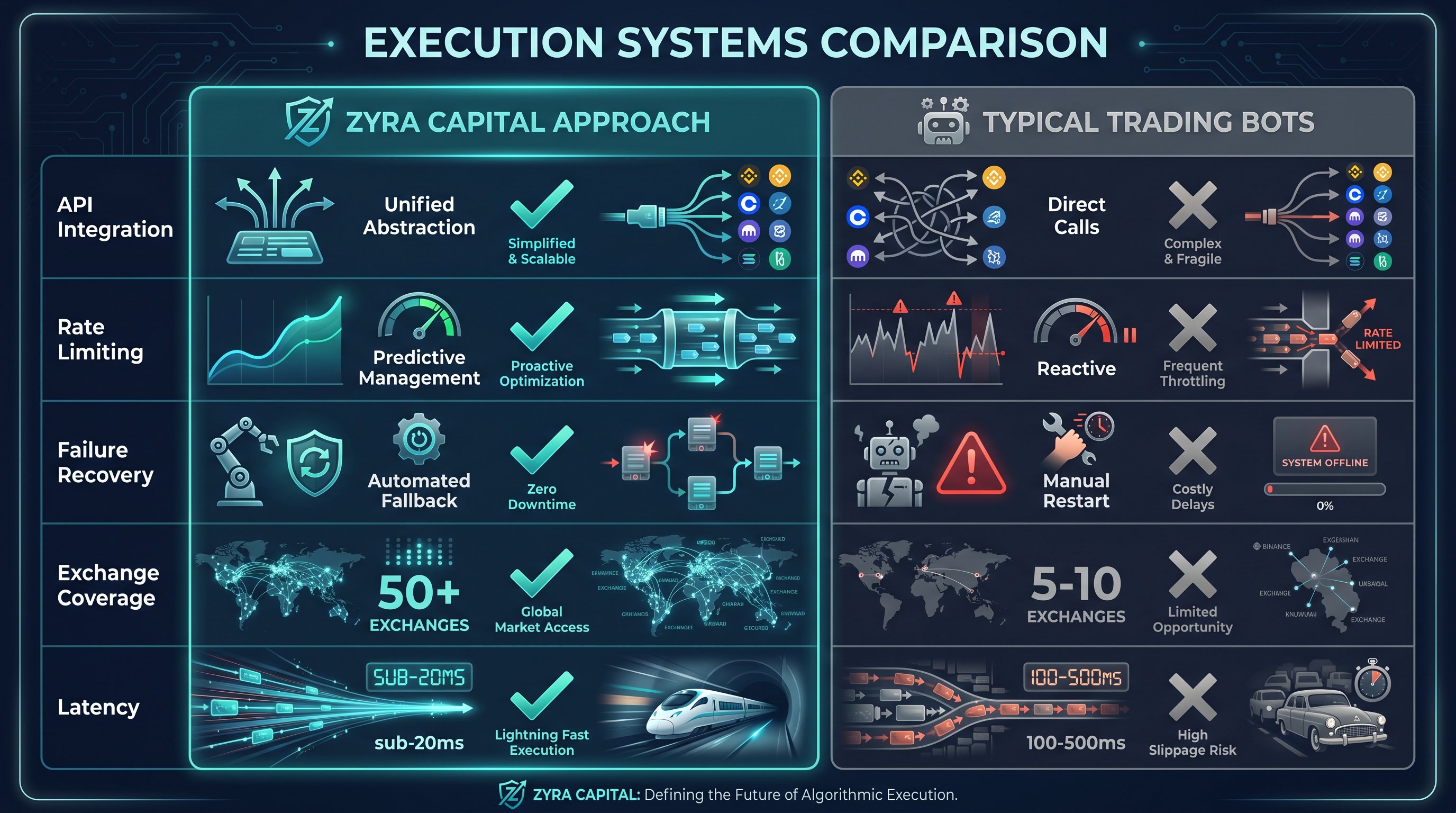
Arbitrage opportunities last 100-500 milliseconds. H100 GPU clusters evaluate 5,000+ opportunities across 50 exchanges in under 10ms—3× faster than competitors.