
Is AI Crypto Trading Safe? What Investors Should Know About Infrastructure, Risk, and Execution
AI crypto trading is not risk-free. This Zyra Capital guide explains how investors should evaluate infrastructure, risk controls, execution quality, transparency, and platform limitations before trusting AI-powered crypto trading systems.
At a Glance: AI crypto trading is not “safe” in the sense of being risk-free. Crypto markets are volatile, fragmented, and operationally complex. The better question is whether a platform explains its infrastructure, risk controls, execution process, transparency standards, and limitations clearly enough for users to perform responsible due diligence.
Executive Summary
No AI trading system, crypto platform, arbitrage engine, or execution infrastructure can guarantee safety or profit. AI can support faster data processing, market analysis, routing decisions, and operational monitoring, but it also introduces model risk, execution risk, and technology risk. Serious users should evaluate AI crypto trading platforms by looking for transparent risk disclosure, infrastructure detail, execution controls, cybersecurity discipline, and realistic language.
Core Thesis
AI crypto trading becomes more credible when platforms stop promising certainty and start explaining infrastructure, risk controls, execution quality, and transparent limitations.
Is AI Crypto Trading Safe?
AI crypto trading is not risk-free. It can be more structured, more automated, and more data-driven than manual trading, but it still operates in volatile digital asset markets. The U.S. Commodity Futures Trading Commission warns that virtual currencies are not legal tender, are not backed by a government or central bank, and can be more volatile than traditional fiat currencies. CFTC virtual currency risk advisory
The U.S. Securities and Exchange Commission has also warned that fraudsters exploit crypto popularity to lure investors into scams. That does not mean every crypto platform is a scam, but it does mean users should be cautious, review disclosures, and avoid platforms that rely on unrealistic return claims or pressure-based marketing. SEC Investor.gov crypto scam alert
Plain answer: AI crypto trading can be built more responsibly when it uses strong infrastructure, risk controls, execution monitoring, and transparent disclosures. It should never be described as safe, guaranteed, or risk-free.
Why “Safe” Is the Wrong Question
In finance, “safe” often implies certainty. Crypto trading does not offer certainty. Prices can move sharply, liquidity can vanish, exchanges can fail, APIs can degrade, and models can be wrong. A more useful question is:
How does the platform identify, limit, monitor, and disclose risk?
That question is much more important for evaluating AI crypto trading because the presence of AI does not automatically make a system safer. AI can help analyze data and automate workflows, but without controls it can also scale mistakes faster.
What Makes an AI Crypto Trading Platform More Trustworthy?
A trustworthy platform should explain how it operates, where its limits are, and what risks remain. The best trust signals are practical and verifiable: infrastructure, execution controls, risk limits, source documentation, and clear disclaimers.
The Main Risks Investors Should Understand
AI does not remove the core risks of digital asset markets. It changes how decisions are made and executed. Serious users should understand the risks below before relying on any AI crypto trading system.
Infrastructure: The Foundation of Safer Execution
For AI crypto trading, infrastructure matters because market signals are only useful if they can be acted on reliably. A model may detect an opportunity, but execution quality determines whether that signal can survive real exchange conditions.
Important infrastructure components include:
-
Market-data ingestion: real-time order books, prices, liquidity, fees, funding rates, and venue status.
-
Model systems: AI research, signal evaluation, simulation, and strategy scoring.
-
Execution routing: exchange-specific API adapters, route selection, and latency-aware order handling.
-
Risk controls: exposure limits, circuit breakers, allocation rules, and kill-switch logic.
-
Reconciliation: post-trade checks comparing internal records with exchange-reported balances and fills.
Risk Controls: Guardrails Before Automation
Autonomy is only useful when it operates inside boundaries. In AI trading, the most important safeguards are not cosmetic dashboards; they are hard constraints that limit what the system can do under changing market conditions.
Examples include exposure caps, maximum order size, venue-level restrictions, circuit breakers, degraded-venue blocks, model confidence thresholds, partial-fill recovery rules, and manual override procedures. These controls help prevent a system from turning a technical issue into a financial issue.
Execution Quality: Why Signals Alone Are Not Enough
Many AI trading claims focus on signal generation. But in crypto markets, the execution layer is just as important. A signal can be accurate and still fail if an exchange rejects the order, the order book changes, latency increases, or one side of a multi-leg trade only partially fills.
This is why serious platforms discuss exchange connectivity, rate limits, order routing, failure recovery, and reconciliation. Binance’s API documentation, for example, describes rate limits and 429 behavior for excessive requests, illustrating why venue-specific infrastructure matters. Binance Spot API rate-limit documentation
AI Risk Management: What Responsible Platforms Should Consider
AI introduces its own risk layer. Models can drift, overfit, hallucinate, misclassify market conditions, or behave differently outside historical test environments. NIST’s AI Risk Management Framework is a useful reference point because it emphasizes identifying, assessing, and managing AI-related risks rather than assuming AI is automatically reliable. NIST AI Risk Management Framework
For AI crypto trading, responsible AI risk management should include monitoring, validation, human-defined constraints, rollback procedures, and clear separation between research outputs and live execution permissions.
How Zyra Capital Approaches the Question of Safety
Zyra Capital should not be evaluated as a risk-free investment promise. It should be evaluated as an AI trading infrastructure and research platform: a system focused on market data, model infrastructure, execution routing, risk controls, and reconciliation.
The strongest trust position is not “Zyra Capital is safe.” The stronger and more responsible position is: Zyra Capital emphasizes infrastructure, transparency, risk controls, and execution discipline in a market where risk cannot be eliminated.
Red Flags to Avoid in AI Crypto Trading
Users should be cautious when a platform presents AI as a guarantee instead of a tool. Responsible financial technology should make risk easier to understand, not hide it behind hype.
Questions Users Should Ask Before Using an AI Crypto Trading Platform
Does the platform clearly state that returns are not guaranteed?
-
Does it explain how AI is used: signal detection, execution routing, risk scoring, or portfolio automation?
-
Does it describe execution risks such as slippage, partial fills, rate limits, rejected orders, and venue downtime?
Does it provide a risk disclosure page?
Does it explain custody, API permissions, and access controls?
Does it avoid pressure-based marketing and unrealistic profit claims?
Does it provide enough information for users to perform due diligence?
Frequently Asked Questions
Is AI crypto trading safe?
AI crypto trading is not risk-free. It may be supported by better infrastructure, automation, and risk controls, but users can still lose money due to market volatility, liquidity issues, execution failures, exchange problems, cybersecurity risks, and model errors.
Can AI trading guarantee profit?
No. No AI model, trading bot, arbitrage engine, or execution system can guarantee profit. Any platform suggesting guaranteed returns should be treated with caution.
What makes an AI crypto platform more trustworthy?
Trust improves when a platform explains its infrastructure, discloses risks, avoids exaggerated return claims, uses clear controls, monitors execution quality, and provides transparent documentation.
Why does execution infrastructure matter?
Execution infrastructure determines whether a signal can be translated into completed orders under real exchange conditions. It manages routing, rate limits, fills, failures, and reconciliation.
Should users invest only because a platform uses AI?
No. AI is a tool, not a guarantee. Users should evaluate the full platform: risk disclosures, infrastructure, controls, transparency, team credibility, and suitability for their own risk tolerance.
Related Zyra Capital Research
-
AI Agents vs Crypto Trading Bots: Why Execution Infrastructure Matters
-
The Execution Gap: How Zyra Capital Connects AI Trading Signals to 50+ Crypto Exchanges
-
AI-Powered Crypto Arbitrage with H100 GPUs and Reinforcement Learning
The Bottom Line
AI crypto trading should never be treated as safe, guaranteed, or risk-free. The more responsible standard is transparency: clear risk disclosure, infrastructure detail, execution controls, AI risk management, and honest limitations. That is the framework serious users should apply when evaluating any AI-powered crypto trading platform.
Read Zyra Capital Risk Disclosure
Sources and References
-
CFTC Customer Advisory: Understand the Risks of Virtual Currency Trading
-
SEC Investor.gov: 5 Ways Fraudsters May Lure Victims Into Crypto Asset Scams
Disclaimer: This content is for informational purposes only and does not constitute financial, investment, legal, tax, or trading advice. Cryptocurrency and digital asset markets involve substantial risk, including possible loss of principal. AI systems, trading infrastructure, internal research, examples, or historical observations do not guarantee future results. AI crypto trading may involve model risk, execution risk, liquidity risk, exchange risk, counterparty risk, cybersecurity risk, and technology risk. Zyra Capital provides software tools and research infrastructure and does not act as a broker, advisor, or investment manager.
Mehr aus Market Analysis

The Big Money Is Coming On-Chain: Why AI Crypto Infrastructure Could Define the Next Bull Market
Wall Street, tokenization, stablecoins, and AI-driven market infrastructure are reshaping crypto. Zyra Capital explores why the next bull market may be driven not just by price action, but by institutional liquidity, smarter execution systems, and the financial infrastructure moving on-chain.

AI Arbitrage in a Volatile Market: Why Speed Matters When Prices Move
When crypto markets turn volatile, price gaps can open and close in seconds. Zyra Capital explains why AI arbitrage, execution speed, and infrastructure matter when Bitcoin and digital assets move fast.
How AI Captures Arbitrage Opportunities in 100 Milliseconds: Inside Zyra Capital's Multi-Exchange Strategy
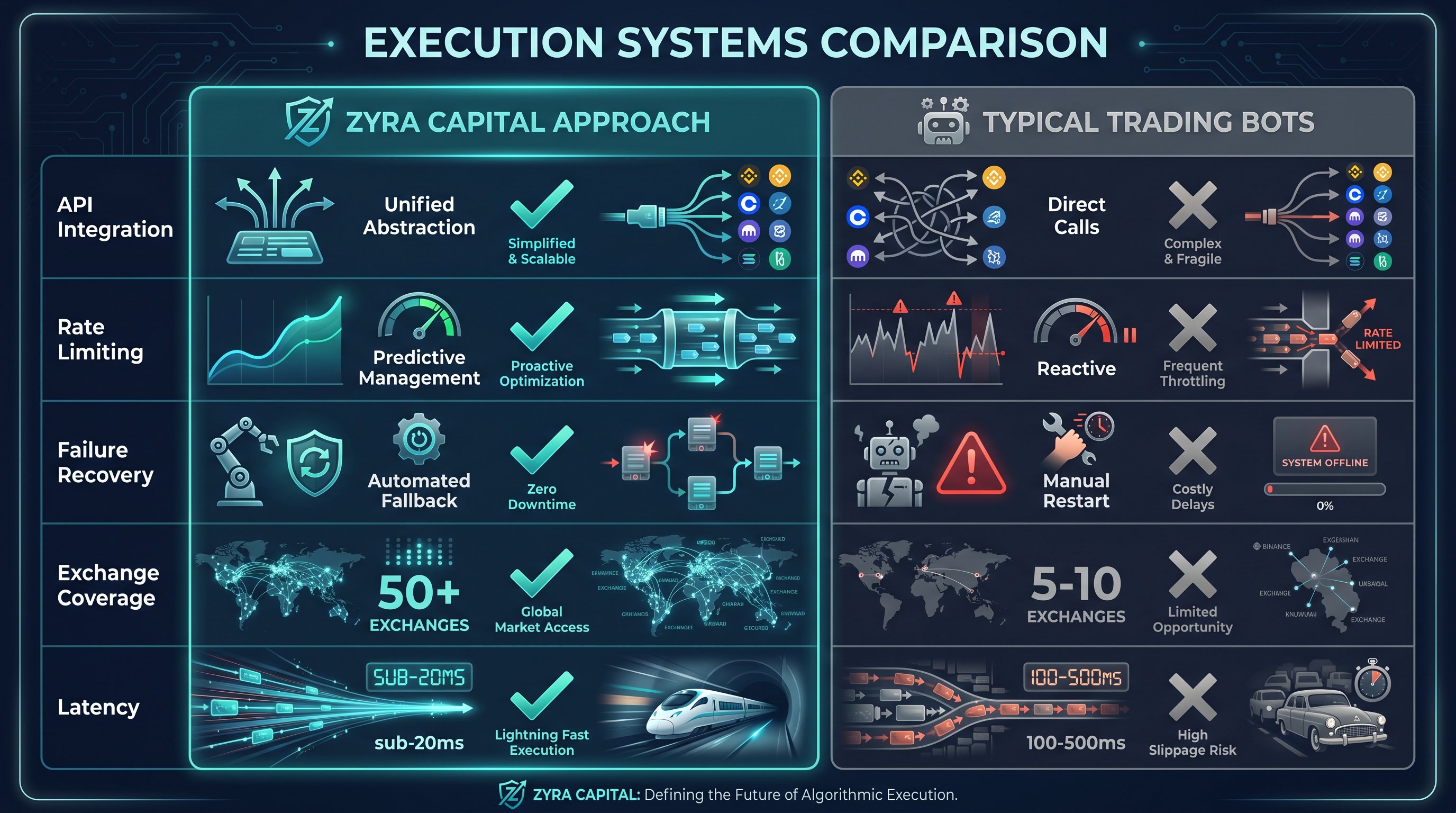
Arbitrage opportunities last 100-500 milliseconds. H100 GPU clusters evaluate 5,000+ opportunities across 50 exchanges in under 10ms—3× faster than competitors.