

AI Arbitrage in a Volatile Market: Why Speed Matters When Prices Move
When crypto markets turn volatile, price gaps can open and close in seconds. Zyra Capital explains why AI arbitrage, execution speed, and infrastructure matter when Bitcoin and digital assets move fast.
In crypto, the opportunity often disappears before the headline appears.
When Bitcoin moves fast, exchanges do not always move together. One venue may reprice first, another may lag for seconds, liquidity can shift, order books can thin out, and a temporary spread can open between markets before most traders even notice it exists.
That narrow delay is the execution gap. For AI arbitrage, it is one of the most important problems to solve.
The Core Idea
Volatile markets do not only create risk. They can also expose temporary inefficiencies. The challenge is that those inefficiencies are only useful when a system can detect, filter, route, execute, and reconcile faster than the market closes the window.
For Zyra Capital, AI crypto arbitrage is not about guessing the next candle or chasing market hype. It is about monitoring fragmented crypto markets, identifying measurable price differences, applying risk controls, and acting only when execution conditions are strong enough.
In a volatile market, prediction gets attention. Execution creates the difference.
Why This Matters Now
The current crypto market is being shaped by volatility, selective liquidity, and renewed attention toward infrastructure-driven trading systems. Bitcoin remains the center of market attention, and when it moves quickly, the rest of the digital asset market often reacts with it.
That environment can feel uncomfortable for manual traders. But for AI-powered execution infrastructure, volatility is also a reason to pay closer attention. Fast movement can expose price gaps, liquidity imbalances, and short-lived inefficiencies across exchanges.
- Volatility exposes inefficiency: fast market moves can create temporary price gaps across exchanges.
- Speed decides whether the spread is usable: a visible opportunity can disappear before slow systems complete the trade path.
- AI arbitrage is not prediction: it focuses on measurable market differences, not simply whether Bitcoin moves up or down.
- Infrastructure separates serious systems from simple bots: data, routing, risk checks, liquidity filters, and reconciliation all matter.
- Zyra Capital is built around execution quality: the platform focuses on disciplined infrastructure for volatile digital asset markets.
Volatility Does Not Move Every Exchange at the Same Speed
Crypto markets are fragmented by design. Bitcoin, Ethereum, stablecoins, and other major digital assets trade across many exchanges, each with its own liquidity, user base, order-book depth, fee structure, API behavior, and execution conditions.
During calm periods, prices tend to stay closer together. During volatile periods, that synchronization can weaken. One venue may absorb demand faster. Another may lag. A third may show thinner liquidity or wider spreads.
This fragmentation is one reason arbitrage opportunities can exist in crypto markets. The same asset may briefly trade at different effective prices across different venues.
But seeing a price difference is not enough. The difference must be large enough, liquid enough, fast enough, and safe enough to act on.
What AI Arbitrage Actually Means
AI arbitrage is the use of automated intelligence to monitor price differences, liquidity changes, and execution conditions across multiple crypto venues.
In simple terms, the system looks for situations where the same or related digital assets are priced differently across exchanges. If a spread appears large enough after fees, slippage, liquidity checks, and risk controls, the system can identify a potential arbitrage opportunity.
The important point is that arbitrage is different from directional trading.
Directional trading asks: will the asset go up or down?
Arbitrage asks: is there a temporary price difference between venues, and can it be executed before the difference disappears?
That distinction matters because AI arbitrage is not built around emotional market prediction. It is built around detection, filtering, execution, and control.
A Simple Example of a Crypto Arbitrage Window
Imagine Bitcoin is quoted at one price on Exchange A and slightly higher on Exchange B. At first glance, the difference may look like an opportunity.
But the visible spread is only the first step. A disciplined system still needs to answer several questions before acting:
- Is the spread large enough after trading fees?
- Is there enough liquidity on both venues?
- Will slippage erase the opportunity?
- Can the required orders be executed quickly enough?
- Are there any exchange-side delays, rate limits, or abnormal conditions?
- Can the system reconcile the completed activity correctly?
A manual trader may see the price difference. An AI arbitrage system must decide whether that difference is actually executable.
This is where infrastructure separates a real execution system from a simple price-alert tool.
The Execution Gap: Where Theoretical Edge Disappears
The execution gap is the distance between detecting a trading opportunity and completing the required action before the market changes.
In AI-driven crypto arbitrage, that gap is often where theoretical edge disappears. A system may detect a spread correctly, but if routing is slow, liquidity is insufficient, fees are miscalculated, or reconciliation fails, the opportunity may not translate into a usable outcome.
This is why speed cannot be separated from infrastructure. A fast alert is not enough. A strong system needs fast data, fast filtering, fast routing, fast execution, and fast verification.
Zyra Capital explores this concept in more depth in its article on the execution gap in multi-exchange trading systems.
Manual Trading vs AI Arbitrage Infrastructure
Manual Trading
- Market monitoring is limited by human attention and screen time.
- Reaction speed is often delayed during fast market movement.
- Emotion, hesitation, and bias can affect decision quality.
- Price gaps are often noticed after the spread has already narrowed.
- Risk control depends heavily on individual discipline.
- Post-trade verification often requires manual review and account checking.
AI Arbitrage Infrastructure
- Markets can be monitored continuously across multiple exchanges.
- Price differences can be detected and evaluated automatically.
- Rules, filters, and risk checks guide execution decisions.
- Spreads can be evaluated while they are still active.
- Risk controls are built into the execution framework.
- Reconciliation and monitoring workflows help verify completed activity.
Why Speed Matters When Prices Move
In volatile markets, opportunity windows compress. A price gap may appear, narrow, and close before most traders finish checking the chart.
Speed matters across the entire execution chain:
- Market data speed: how quickly exchange data is received and normalized.
- Signal speed: how quickly the system identifies whether a spread is meaningful.
- Decision speed: how quickly fees, liquidity, slippage, and risk are evaluated.
- Routing speed: how quickly the system selects the correct venue path.
- Execution speed: how quickly orders can be placed, confirmed, and managed.
- Reconciliation speed: how quickly balances, fills, and outcomes are verified after execution.
A weak system may be fast in one area but slow in another. A stronger system is designed around the full chain, from detection to reconciliation.
This is why modern crypto arbitrage is not just a trading strategy. It is an infrastructure problem.
AI Helps Separate Noise From Actionable Signals
Not every price difference is worth acting on. Some spreads are too small. Some disappear too quickly. Some look attractive until fees, slippage, liquidity depth, or execution delay are included.
This is why AI-driven filtering matters.
A serious arbitrage system should not chase every movement. It should evaluate whether the movement is usable under real market conditions.
That means looking at the spread, the route, the liquidity, the cost, the timing, the exchange condition, and the risk framework at the same time.
In volatile markets, the advantage is not only speed. It is speed combined with selectivity.
How Zyra Capital Approaches AI Arbitrage
Zyra Capital is built around the idea that modern crypto arbitrage is an infrastructure problem, not a guessing game.
The platform is designed to monitor fragmented crypto markets, evaluate cross-exchange price differences, apply execution filters, and support disciplined decision-making when market conditions meet the required criteria.
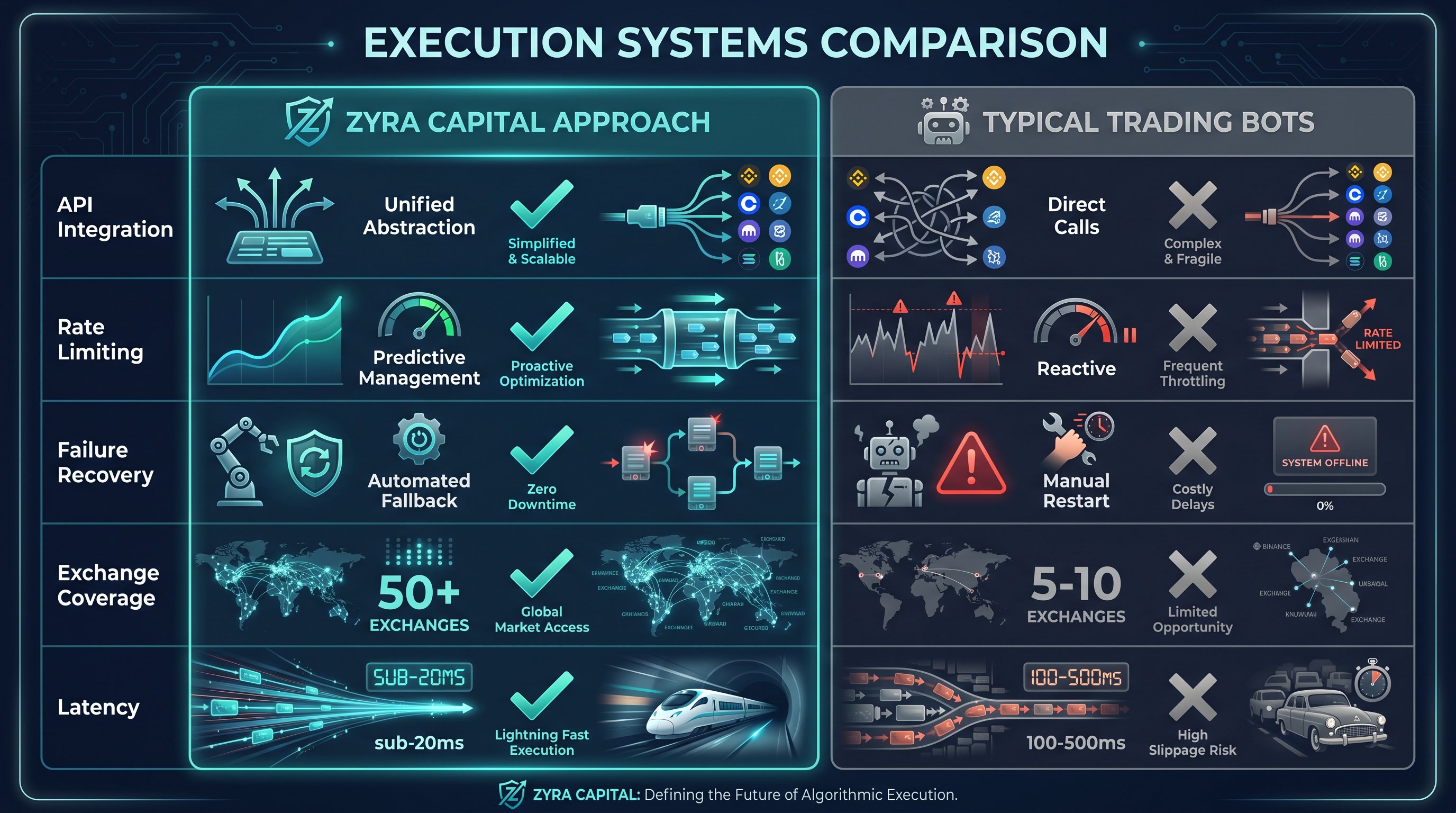
This approach is different from a simple trading bot or a signal group. A bot may automate a rule. A signal group may tell users what to watch. Infrastructure must do more: ingest data, evaluate market state, manage routing, handle failures, apply controls, and verify outcomes.
This infrastructure-first positioning is important because Zyra Capital is not trying to present arbitrage as a simple yield promise. The platform’s value comes from system design, market monitoring, execution discipline, and risk-aware operation.
Readers who want to understand this deeper can explore Zyra Capital's related article on AI agents vs crypto trading bots.
Why Infrastructure Matters More Than Hype
Crypto markets often reward attention, but attention is not infrastructure.
A headline can move sentiment. A social trend can create temporary volume. But arbitrage systems require something more durable: compute capacity, market data pipelines, exchange connectivity, execution logic, monitoring, and risk controls.
This is why Zyra Capital emphasizes infrastructure as the foundation of its AI-powered arbitrage approach.
The goal is not to chase hype. The goal is to build systems capable of monitoring market fragmentation and acting only when execution conditions meet defined standards.
Zyra Capital's public infrastructure materials explain how AI training, exchange data, and execution workflows connect inside a production-oriented system. For a deeper technical view, see Building AI Trading Infrastructure with NVIDIA H100.
A Positive Market View: Resets Can Create Cleaner Conditions
A market reset can be uncomfortable, but it can also create a cleaner setup for the next phase.
Excess optimism cools down. Overleveraged positions are reduced. Traders become more selective. Liquidity begins to matter again. In that environment, execution infrastructure can become more valuable because the market rewards discipline more than noise.
Nobody can call the exact bottom with certainty. But investors can watch for signs that conditions are becoming more constructive:
- Bitcoin stabilizing after periods of heavy selling pressure.
- ETF-flow data improving after periods of outflow.
- Liquidity returning to major trading venues.
- Volatility creating more exchange-level price fragmentation.
- Stronger participation after a fear-driven reset.
For AI arbitrage platforms, the focus is not on predicting every market move. The focus is on being ready when movement creates measurable inefficiency.
Bitcoin Volatility Can Increase the Need for Better Execution
Bitcoin remains the center of crypto market attention. When Bitcoin moves sharply, liquidity, spreads, order-book depth, and sentiment can shift across the entire digital asset market.
During those moments, execution quality becomes more important. A slow or poorly designed system can turn a visible spread into a missed opportunity. A disciplined system can evaluate whether the opportunity is real, whether it fits the rules, and whether the execution path is acceptable.
This is why speed should not be treated as a marketing word. In AI arbitrage, speed is part of the risk-control framework.
The Real Edge: Speed, Discipline, and Controls
The best arbitrage systems are not built only to move quickly. They are built to know when not to move.
That is especially important in volatile markets.
When prices move fast, low-quality systems can become reckless. They may chase spreads that are already gone, ignore slippage, underestimate liquidity constraints, or treat every price difference as an opportunity.
A stronger approach combines:
- Fast market monitoring across multiple exchanges.
- AI-assisted filtering to separate noise from usable spreads.
- Execution logic that accounts for liquidity, fees, and slippage.
- Risk controls that help prevent overexposure to unstable conditions.
- Reconciliation systems that verify completed activity.
- Infrastructure capacity to support consistent platform operations.
This is the difference between reacting to volatility and operating through volatility.
Zyra Capital also explains its broader user-protection framework in How Zyra Capital Protects Users: Security, Custody, Compliance, and Risk Controls.
Preparation Beats Prediction
Many investors wait until the market already looks obvious. By then, conditions may have changed.
In crypto, some of the strongest windows can appear before sentiment fully recovers. This is why preparation matters. Infrastructure, account readiness, capital planning, and platform access can all become more important when the market begins moving again.
For users watching the next crypto opportunity window, the question is not only whether prices will move.
The better question is whether their systems are prepared when they do.
Explore Zyra Capital
Zyra Capital is building AI-powered crypto arbitrage infrastructure for users who want a more systematic way to participate in volatile digital asset markets.
If you want to see how Zyra Capital approaches market monitoring, execution discipline, and multi-exchange arbitrage infrastructure, visit the platform below.
Frequently Asked Questions
What is AI arbitrage in crypto?
AI arbitrage in crypto uses automated systems to monitor price differences across exchanges, evaluate whether those differences are executable after fees and risks, and identify potential opportunities created by market fragmentation.
Why does speed matter in crypto arbitrage?
Speed matters because price gaps can close quickly. A system must detect the spread, validate liquidity, account for fees, check risk conditions, and execute before the opportunity disappears.
Does AI arbitrage depend on Bitcoin going up?
Not directly. Arbitrage is different from directional trading. It focuses on price differences across venues rather than simply predicting whether Bitcoin will rise or fall.
Why do crypto prices differ between exchanges?
Prices can differ because exchanges have different liquidity, order books, users, regions, trading activity, fees, and execution speeds. During volatile periods, these differences can become more visible.
Is crypto arbitrage risk-free?
No. Crypto arbitrage is not risk-free. Fees, slippage, exchange outages, liquidity changes, latency, model risk, execution risk, market volatility, and counterparty risk can all affect outcomes. Serious platforms must use controls and transparent risk disclosure.
How does Zyra Capital use AI in crypto arbitrage?
Zyra Capital uses AI-powered infrastructure to monitor market inefficiencies, evaluate execution conditions, and support a disciplined approach to multi-exchange crypto arbitrage.
Final Thought
Volatility is not automatically an opportunity. But volatility can create conditions where opportunity becomes visible to systems built for speed, discipline, and precision.
AI arbitrage exists because crypto markets remain fragmented. Prices move across different exchanges at different speeds. Liquidity changes constantly. Execution quality matters.
When markets move fast, the advantage belongs to infrastructure that can move intelligently.
Zyra Capital is built around that idea: using AI-powered infrastructure to monitor market inefficiencies, evaluate execution conditions, and support a more disciplined approach to crypto arbitrage.
In a volatile market, prediction gets attention. Execution creates the difference.
Further Reading
- CoinDesk: Bitcoin live price and market data
- SoSoValue: Bitcoin ETF and crypto market data dashboards
- Zyra Capital: The Execution Gap in Multi-Exchange Trading Systems
- Zyra Capital: Building AI Trading Infrastructure with NVIDIA H100
- Zyra Capital: AI Agents vs Crypto Trading Bots
- Zyra Capital: Security, Custody, Compliance, and Risk Controls
This article is for informational purposes only and does not constitute financial advice, investment advice, trading advice, legal advice, tax advice, or a guarantee of returns. Digital asset markets are volatile, and all participation involves risk, including potential loss of principal. AI systems, arbitrage infrastructure, security controls, custody workflows, or market analysis do not eliminate market risk, liquidity risk, execution risk, technology risk, exchange risk, counterparty risk, or model risk. Availability of Zyra Capital products, plans, or features may be subject to platform rules, capacity, eligibility requirements, and jurisdictional restrictions.
Mehr aus Market Analysis

The Big Money Is Coming On-Chain: Why AI Crypto Infrastructure Could Define the Next Bull Market
Wall Street, tokenization, stablecoins, and AI-driven market infrastructure are reshaping crypto. Zyra Capital explores why the next bull market may be driven not just by price action, but by institutional liquidity, smarter execution systems, and the financial infrastructure moving on-chain.
Is AI Crypto Trading Safe? What Investors Should Know About Infrastructure, Risk, and Execution
AI crypto trading is not risk-free. This Zyra Capital guide explains how investors should evaluate infrastructure, risk controls, execution quality, transparency, and platform limitations before trusting AI-powered crypto trading systems.
How AI Captures Arbitrage Opportunities in 100 Milliseconds: Inside Zyra Capital's Multi-Exchange Strategy
Arbitrage opportunities last 100-500 milliseconds. H100 GPU clusters evaluate 5,000+ opportunities across 50 exchanges in under 10ms—3× faster than competitors.