Inside Zyra Capital's AI Trading Infrastructure: How NVIDIA H100 Clusters Power Autonomous Crypto Execution
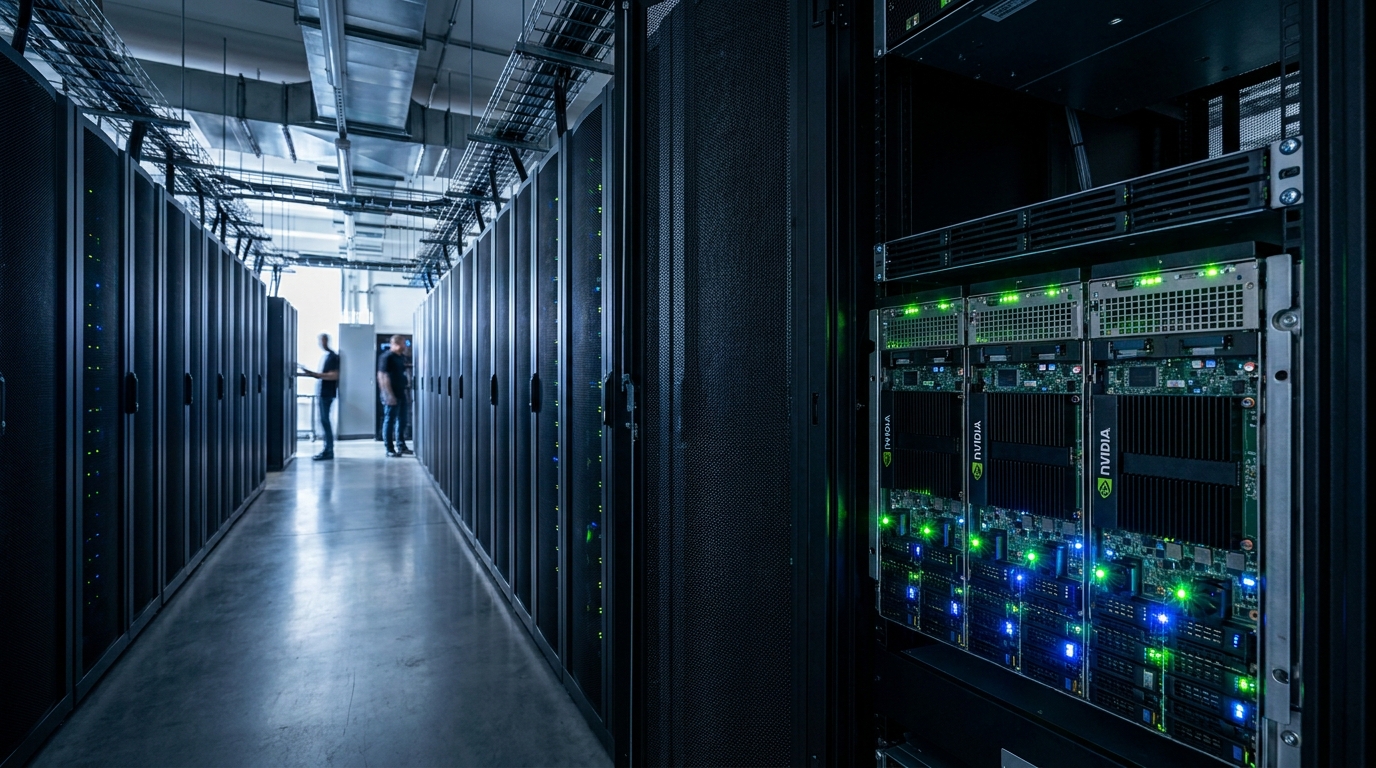
In March 2025, Zyra Capital completed production deployment of its AI training infrastructure—NVIDIA H100 GPU clusters, AMD EPYC processors, and sub-20ms InfiniBand networking purpose-built for autonomous multi-exchange crypto trading.
At a Glance: Zyra Capital completed the production deployment of its AI training infrastructure in March 2025—NVIDIA H100 GPU clusters, AMD EPYC processors, and sub-20ms InfiniBand networking, purpose-built for autonomous multi-exchange crypto execution.
The Infrastructure Problem Most AI Trading Systems Never Solve
In algorithmic crypto trading, infrastructure quietly determines outcomes. Strategies that look elegant on paper collapse when latency drifts, when GPU availability becomes unpredictable, or when an exchange API change cascades through a fragile data pipeline.
Most early-stage AI trading systems share the same architectural ceiling: they rent cloud GPUs, route traffic over public networks, and treat the trading engine as separate from the model that generates its signals. That works—until it doesn't. When 50+ exchanges produce conflicting price feeds in the same millisecond, and when a model needs to be retrained on yesterday's regime shift before tomorrow's opportunity disappears, shared infrastructure becomes the bottleneck.
This is the problem Zyra Capital set out to solve when designing its production AI training environment. Not "build a trading bot." Not "use machine learning for crypto." But build the underlying computational substrate that enables autonomous trading agents to operate continuously, adaptively, and at an institutional scale.
March 2025 marks when that substrate went live.
Assembling a Team Across Five Disciplines
The infrastructure decisions at Zyra Capital reflect the team that designed them—a leadership group spanning distributed systems, quantitative finance, cybersecurity, capital markets, and cross-border strategy.
Strategic Direction: Irene Fedier
Irene Fedier, Co-Founder and Managing Director, leads cross-border strategy, research direction, and investor relations across both Zyra Research Group and Zyra Capital. Her role defined the operational thesis that shaped every subsequent architecture decision: build infrastructure that institutional capital can deploy into without compromise.
That thesis carries weight. It means rejecting shortcuts that retail-grade trading platforms accept. It means treating uptime, security, and execution reliability as engineering constraints rather than marketing claims.
"Infrastructure earns trust before strategy earns returns. If the system isn't reliable end-to-end, nothing built on top of it matters." — Irene Fedier, Co-Founder & Managing Director
Technical Architecture: Jodesio Michaels
Jodesio Michaels, Co-Founder and CTO, brings a 15-year academic track spanning computer science, distributed systems, machine learning, and quantitative finance. His distributed systems background directly shaped Zyra's decision to architect training as a multi-node parallel workload rather than a single-machine pipeline—a decision that lets the platform scale model complexity without rebuilding the underlying stack.
Execution Systems: Jeremy Campbell
Jeremy Campbell, Founding Execution Systems Engineer, owns the layer where AI decisions become real trades. In trading infrastructure, this is where milliseconds compound into basis points. His work defines how signals from the training cluster reach exchange order books—and how failure scenarios (partial fills, exchange downtime, API throttling) are absorbed without disrupting the broader system.
Security Posture: Todd Clark
Todd Clark, Cybersecurity Lead at Zyra Research Group, designed the security architecture protecting the stack. AI trading systems handle exchange API credentials, custody-adjacent permissions, and proprietary model weights. A single misconfigured access boundary can be catastrophic. Todd's framework treats security as a continuous engineering discipline, not a compliance checkbox.
Commercial & Partnership Layer: Stefan Schneider & Timothy C. Bachmann
Stefan Schneider, Senior Business Development Manager, builds the investor relationships, strategic partnerships, and commercial channels that turn infrastructure into deployed capital. Timothy C. Bachmann, CMO, bridges professional sales discipline with data-driven marketing—translating technical capability into language that institutional and sophisticated retail allocators can evaluate.
The result is a leadership structure where engineering decisions are stress-tested against commercial reality, and commercial commitments are anchored in what the engineering can actually deliver.
Why NVIDIA H100 Architecture Was the Right Choice
Hardware decisions in AI infrastructure aren't about peak specifications—they're about the workload profile the hardware will actually run. For Zyra, that workload is multi-agent reinforcement learning operating on real-time market microstructure data.
The GPU Decision: NVIDIA H100 80GB
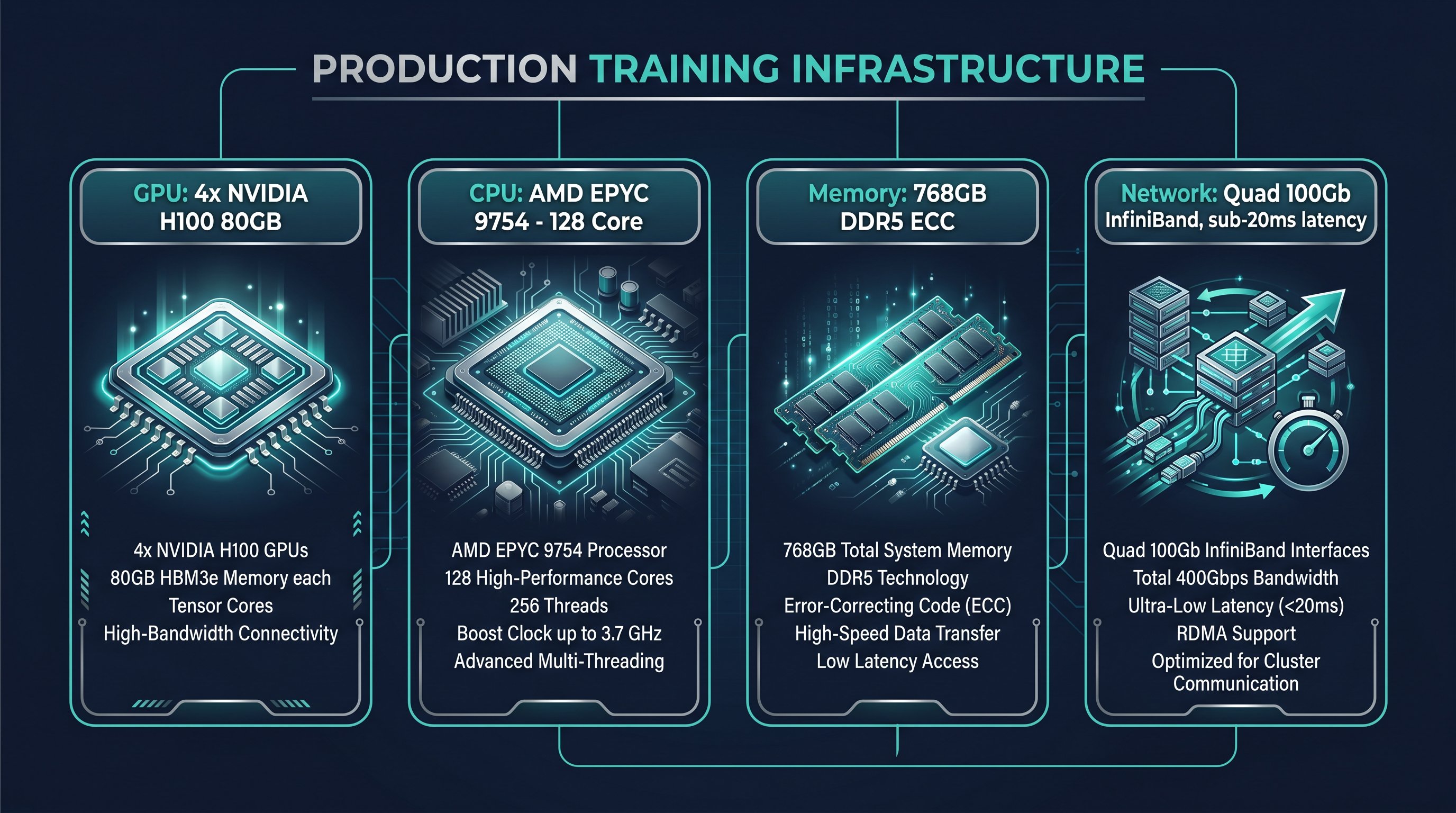
The NVIDIA H100 80GB sits at the center of Zyra's training architecture. Built on NVIDIA's Hopper architecture, the H100 introduces fourth-generation Tensor Cores and the Transformer Engine—hardware-level acceleration specifically designed for the matrix operations underlying modern reinforcement learning and transformer-based models.
For trading AI, three H100 properties matter most:
80GB HBM3 memory per GPU — large enough to hold full order book state across multiple exchanges in-memory during training, avoiding I/O bottlenecks.
FP8 precision support — accelerates training cycles without meaningful precision loss on the model classes Zyra runs.
NVLink interconnect — enables true multi-GPU training, where four H100s function as one logical compute unit rather than four parallel workloads.
The CPU Decision: AMD EPYC 9754
The AMD EPYC 9754 (128 cores, 256 threads) handles the work GPUs aren't optimized for: data preprocessing, order book reconstruction, feature engineering, and the orchestration logic that decides what data flows to which GPU and when.
In a trading AI workload, CPU bottlenecks silently throttle GPU utilization. A 128-core EPYC ensures the GPUs are never starved for data.
The Network Decision: 100Gb InfiniBand
Most AI infrastructure uses standard Ethernet. Zyra uses quad 100 Gb InfiniBand, achieving sub-20ms latency for endpoint exchanges.
This isn't excess. In multi-exchange arbitrage, the difference between 20ms and 80ms latency is the difference between capturing a spread and missing it. InfiniBand's RDMA (Remote Direct Memory Access) also reduces CPU overhead during inter-node communication, which is critical for distributed training.
The Cooling Decision: Liquid-Cooled Sub-Rack
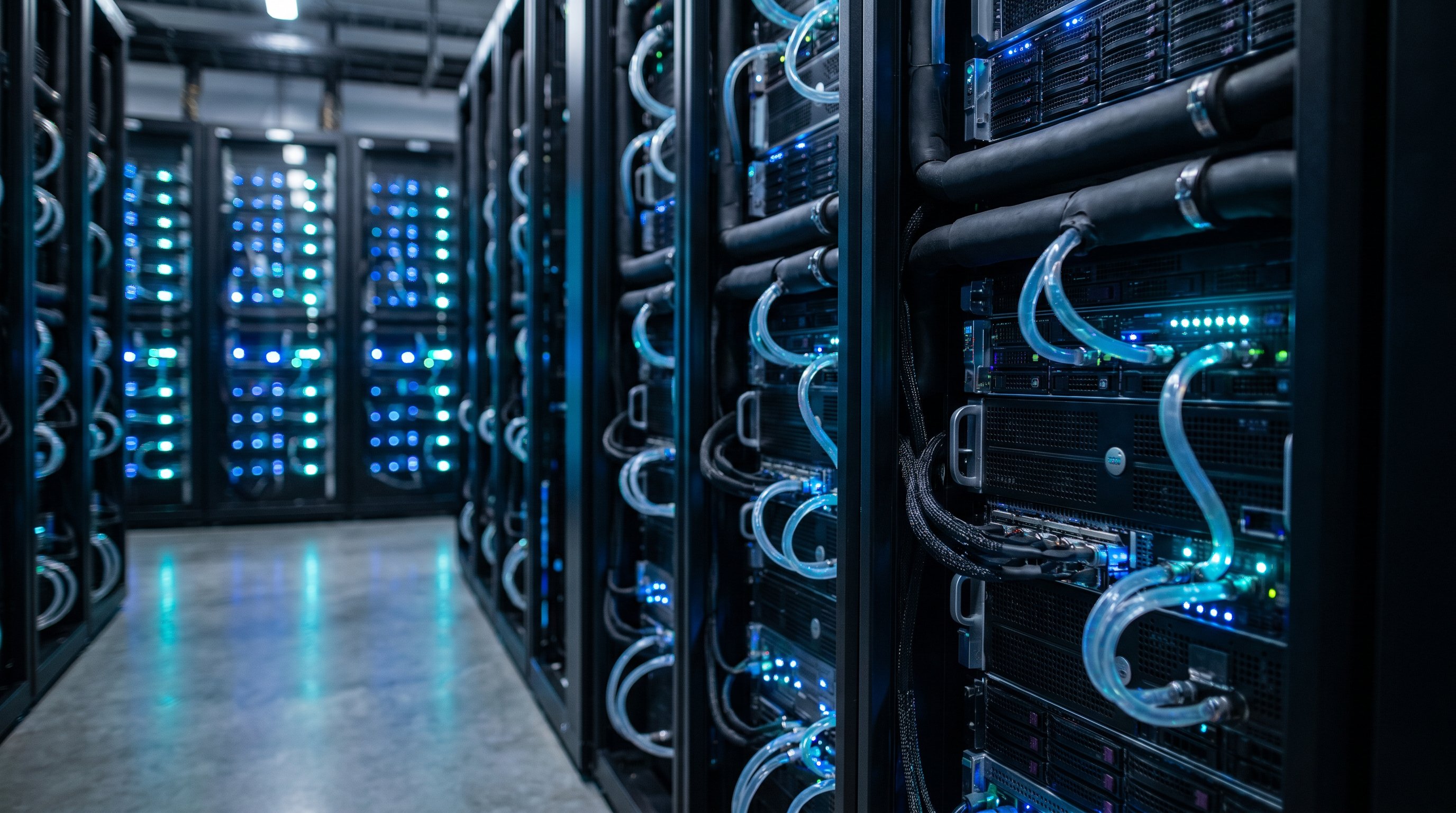
NVIDIA H100s under sustained load generate substantial thermal output. Air cooling works for intermittent workloads. For continuously trained systems, liquid cooling isn't a luxury—it's the only way to maintain sustained boost clocks without thermal throttling.
By the Numbers — March 2025 Production Configuration
• 4× NVIDIA H100 80GB GPUs (Hopper architecture)
• 128 AMD EPYC 9754 cores per node
• 768 GB DDR5 ECC memory @ 6400 MHz
• 16 TB NVMe Gen5 + 2 TB Intel Optane cache
• <20 ms network latency via quad 100 Gb InfiniBand
• 50+ integrated exchange data feeds
• 24/7 continuous operation design target
The Production Training Pipeline, Explained
Hardware alone doesn't generate adaptive trading models. The pipeline that runs on top of it does.
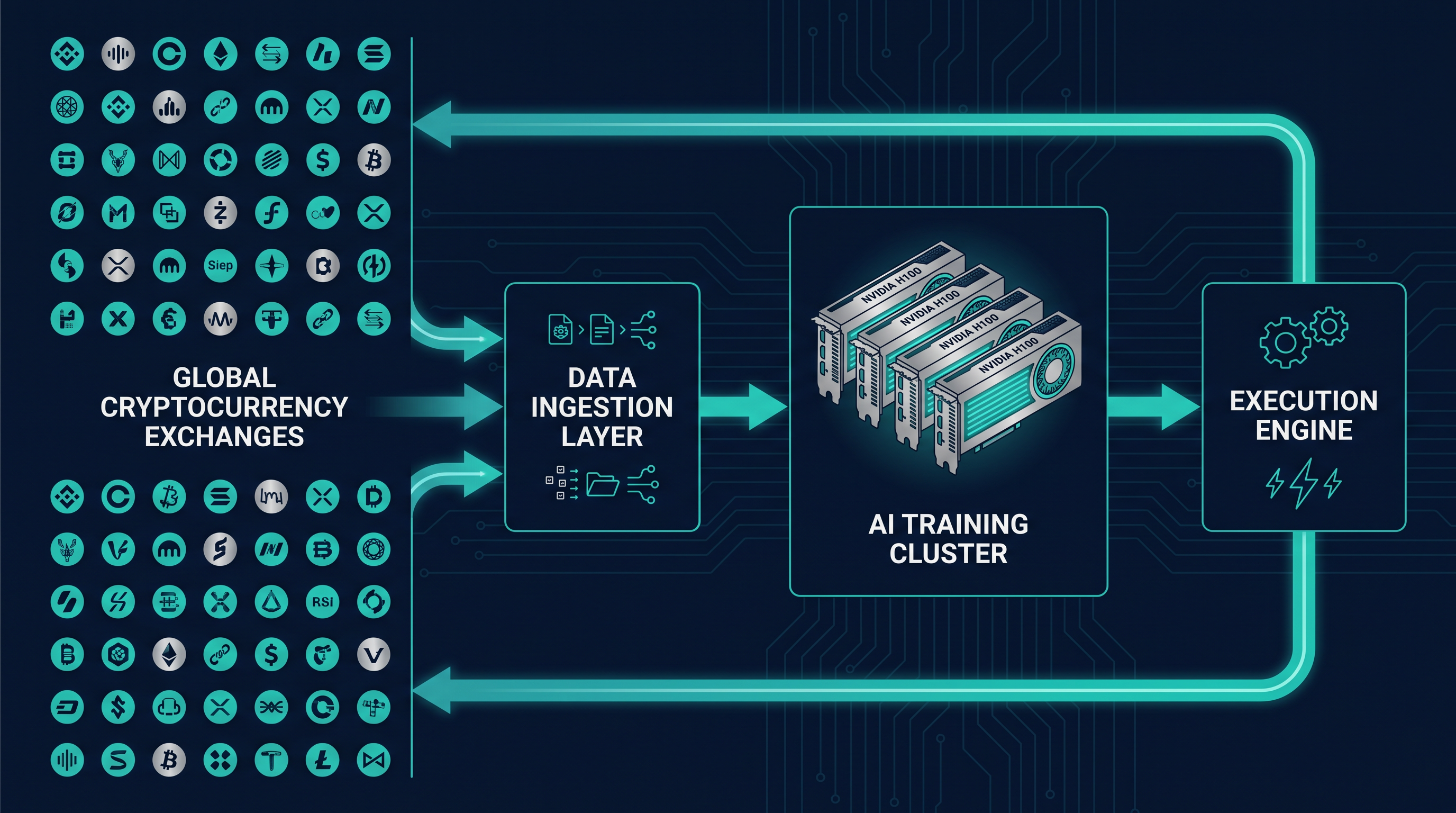
Zyra's production training pipeline operates in four stages:
Stage 1: Real-Time Data Ingestion
Order book data, trade execution logs, and funding rates flow in from 50+ exchanges. Each exchange uses different API conventions, rate limits, and data schemas. The ingestion layer normalizes this heterogeneous data into a unified internal format—the only format the training models ever see.
Stage 2: Feature Engineering
Raw market data becomes model-ready features: spread differentials, liquidity depth scores, funding rate divergences, cross-exchange correlation matrices. This stage is CPU-heavy and benefits directly from the EPYC processor's core count.
Stage 3: Multi-Agent Reinforcement Learning
The H100 cluster trains agents that learn to identify and execute three strategy classes:
Cross-exchange arbitrage — same asset, different exchanges, exploitable spread.
Triangular arbitrage — three trading pairs on one exchange, circular price inefficiency.
Basis trading — spot-versus-derivative pricing dislocations, including funding rate capture.
Agents don't just learn whether an opportunity exists. They learn execution probability—the likelihood that a detected spread will actually be capturable after slippage, partial fills, and latency.
Stage 4: Execution Handoff
Trained models pass signals to the execution layer, where Jeremy Campbell's systems handle order routing, exchange-specific quirks, and failure recovery. This is where AI decisions become real trades.
Inside the March 2025 Deployment Milestone
March 2025 wasn't a single event—it was the moment four parallel engineering tracks converged into a single production system:
Engineering Track, March 2025 Milestone: Distributed Training, Multi-node H100 cluster operational; parallel training pipelines validated. Real-Time Data Layer 50+ exchange integrations normalised into unified internal schema. Execution Systems Sub-20ms exchange routing operational; failure recovery scenarios stress-tested. Security Architecture: Full penetration testing complete; API credential isolation deployed
This wasn't a soft launch. It was the transition from research-grade prototyping to production-capable infrastructure—the kind of system that can run continuously without supervision, recover from individual component failures, and update its own models as market conditions shift.
The distinction matters. Research infrastructure exists to answer questions. The production infrastructure is designed to operate reliably under conditions the researchers didn't anticipate.
What This Infrastructure Enables Next
Production infrastructure is a starting point, not a finish line. With the foundation in place, the engineering focus shifts to model refinement: expanding strategy coverage, improving execution probability estimation, and optimizing capital efficiency across deployed agents.
For investors and partners evaluating AI-driven trading platforms, the infrastructure question is rarely the one that gets asked—but it should be. Systems built on consumer hardware or shared cloud GPUs face structural ceilings on latency, reliability, and cost predictability. Dedicated infrastructure, designed for the specific demands of autonomous trading, represents a different category of operational commitment.
Zyra Capital's March 2025 milestone is what that commitment looks like, made concrete: NVIDIA H100 clusters, AMD EPYC compute, InfiniBand networking, liquid cooling, and the cross-disciplinary team that designed it all to work together.
The next articles in this series will go deeper—into the reinforcement learning architecture, the execution systems that handle 50+ exchange integrations, and the security framework that protects the stack.
Frequently Asked Questions
What makes NVIDIA H100 GPUs suitable for AI trading systems?
The H100's Hopper architecture introduces fourth-generation Tensor Cores and FP8 precision support, both optimised for the matrix operations underlying reinforcement learning and transformer-based models. Its 80GB HBM3 memory allows the full order book state to be held in memory during training, eliminating I/O bottlenecks that constrain smaller GPUs.
Why does Zyra Capital use dedicated hardware instead of cloud GPU services?
Cloud GPU services introduce variable latency, unpredictable availability, and "noisy neighbour" performance degradation. For systems where execution latency directly affects trade outcomes, dedicated infrastructure provides the consistency that shared cloud environments cannot guarantee. It also enables precise network routing optimisation to exchange endpoints.
What is multi-agent reinforcement learning in the context of crypto trading?
Multi-agent reinforcement learning trains multiple AI agents simultaneously, each exploring different strategy variants or market conditions. Agents share learnings, allowing the system to discover robust strategies faster than sequential single-agent training. In crypto markets where regimes shift quickly, this parallel exploration is operationally significant.
How does InfiniBand networking improve trading infrastructure?
InfiniBand provides higher bandwidth and lower latency than standard Ethernet, plus RDMA (Remote Direct Memory Access) that reduces CPU overhead during inter-node communication. For multi-exchange trading systems where milliseconds compound into basis points, sub-20ms latency to exchange endpoints is a structural advantage over standard networking.
What does "market-neutral" mean for AI trading strategies?
Market-neutral strategies generate outcomes independent of overall market direction. Cross-exchange arbitrage, triangular arbitrage, and basis trading all capture inefficiencies between markets rather than betting on price direction. This structural design means the strategies don't require predicting whether crypto prices will go up or down.
How is cybersecurity integrated into AI trading infrastructure?
At Zyra Capital, security is treated as a continuous engineering discipline rather than a compliance overlay. The architecture includes API credential isolation, access control boundaries between system components, continuous penetration testing, and operational security audits—all designed by the dedicated cybersecurity team led by Todd Clark.
About Zyra Capital
Zyra Capital develops infrastructure for autonomous trading—combining real-time data processing, multi-exchange connectivity, and execution systems designed to operate continuously across global cryptocurrency markets. The platform is built and operated by Zyra Research Group LLC, a network of research, infrastructure, and operating entities.
Disclaimer: This content is for informational purposes only and does not constitute financial, investment, or legal advice. Cryptocurrency trading involves substantial risk, including potential loss of principal. Past system capabilities and infrastructure milestones do not guarantee future trading results. Always conduct independent research and consult qualified professionals before making investment decisions. ZyraCapital provides software tools only and does not act as a broker, advisor, or investment manager.