
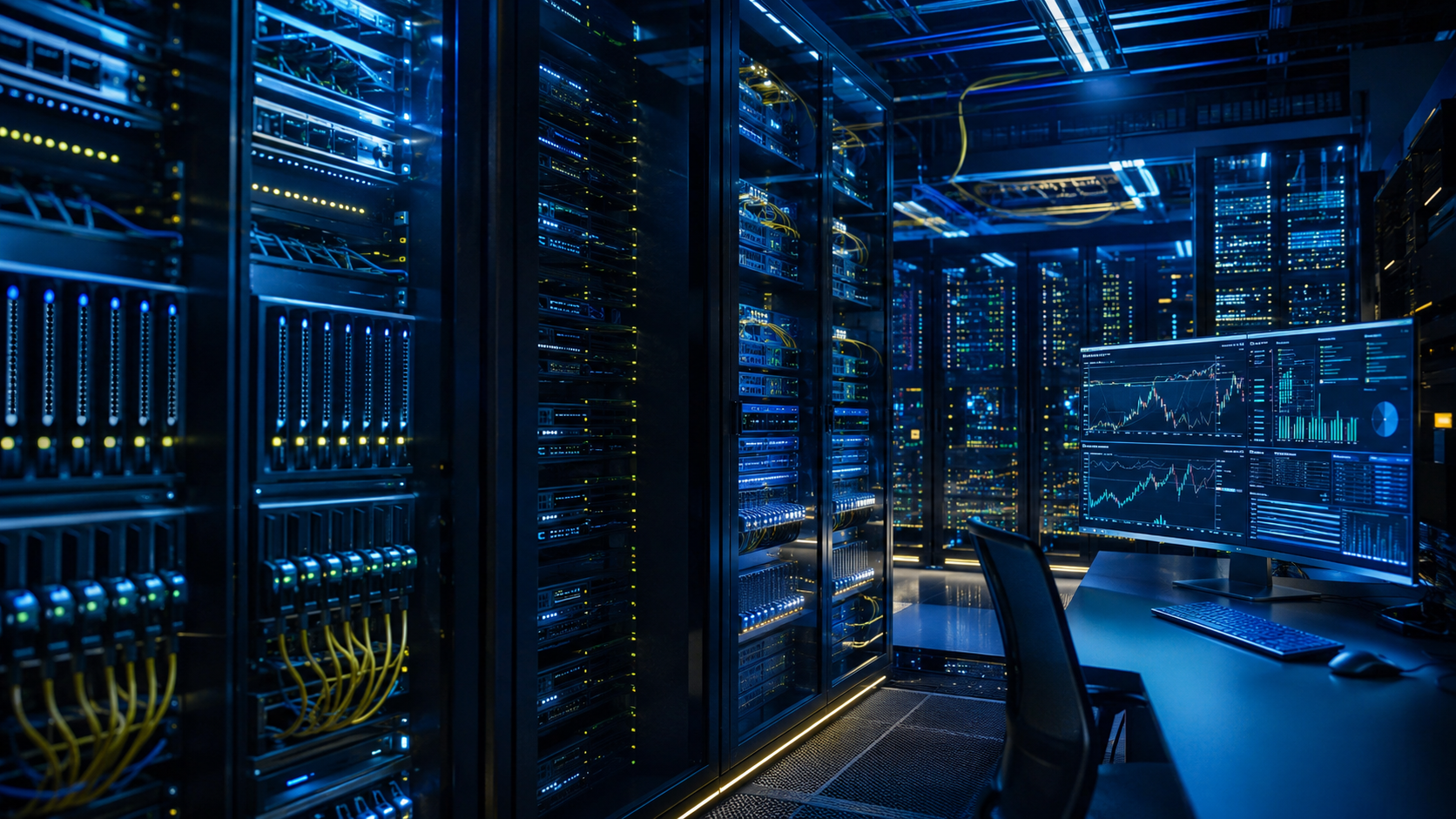
AI Agents vs Trading Bots: Why Crypto Trading’s Next Era Depends on Execution Infrastructure
AI agents are changing the crypto trading narrative, but trust depends on more than automation. Zyra Capital explains why execution infrastructure, risk controls, multi-exchange routing, and reconciliation matter more than another trading bot.
At a Glance: AI agents are becoming one of the most important narratives in crypto, but the real breakthrough is not another trading bot. The next era of crypto trading depends on execution infrastructure: systems that can observe fragmented markets, evaluate risk, route orders, manage failures, and reconcile outcomes across exchanges. Zyra Capital is positioned around that infrastructure-first view of autonomous crypto markets.
Executive Summary
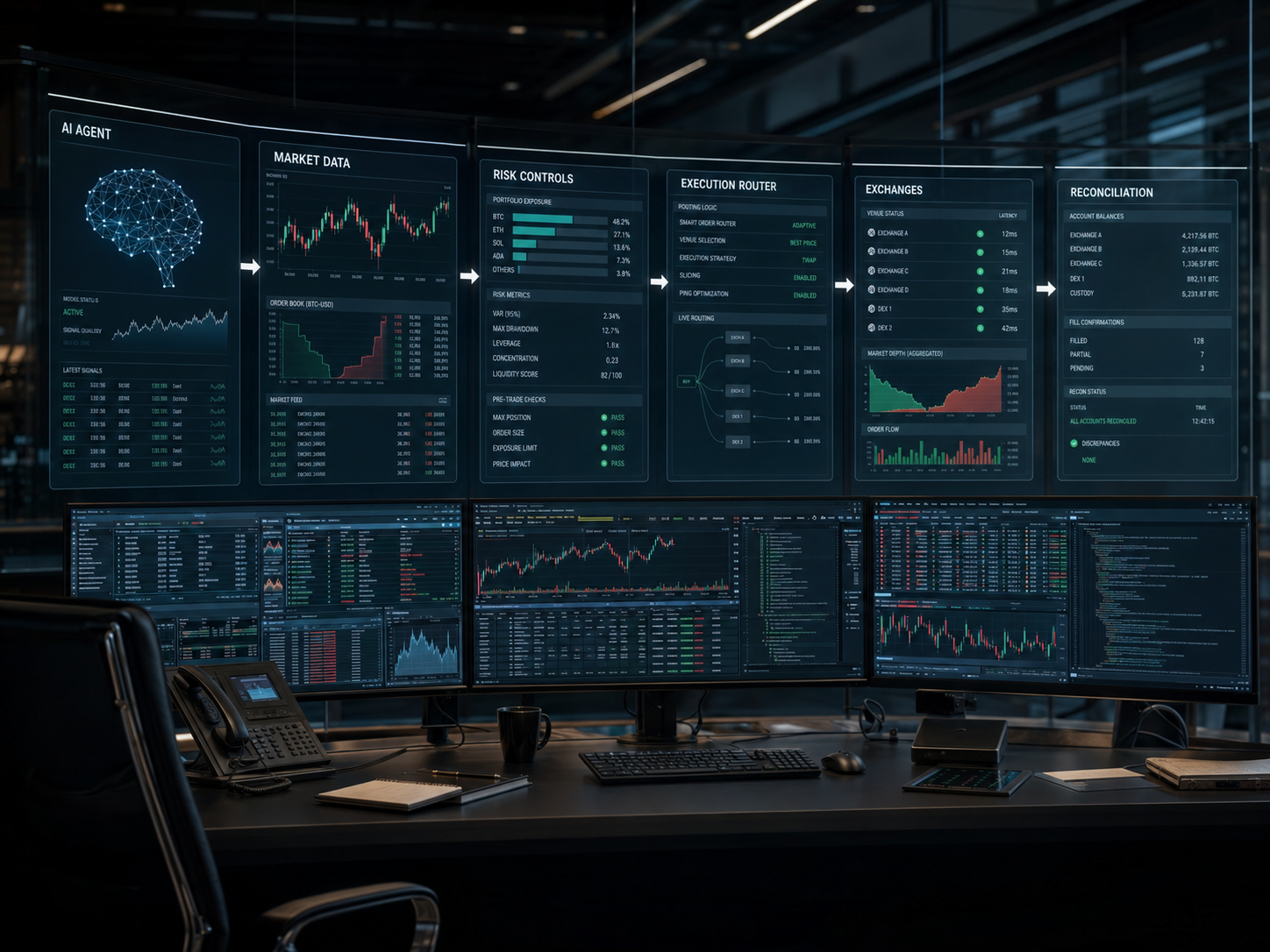
Traditional crypto trading bots automate rules. AI trading agents are broader systems: they can combine market data, model reasoning, execution feedback, and risk controls inside a defined operating framework. That distinction matters because crypto markets are fragmented, fast, and operationally complex. The trust question is no longer whether a platform “uses AI.” The trust question is whether the platform has the infrastructure to make AI useful, controlled, and resilient in live market conditions.
Why This Topic Matters Now
AI agents have moved from a software concept into a crypto-market narrative because blockchains, stablecoins, APIs, and automated wallets create an environment where software can increasingly interact with financial rails. Coinbase Institutional’s 2025 crypto outlook describes crypto markets as entering another phase of maturation and adoption. Coinbase Institutional 2025 Crypto Market Outlook.
But hype creates a trust problem. In trading, autonomy is not valuable unless it is bounded by controls. A system that can decide quickly but cannot manage exchange failures, partial fills, rate limits, stale market data, or reconciliation risk is not a serious trading infrastructure layer. It is only automation with a new label.
What Is an AI Trading Agent?
An AI trading agent is an autonomous or semi-autonomous system that can evaluate market context, select tools or workflows, and act within predefined constraints. In crypto markets, that may include reading order books, comparing venue prices, evaluating liquidity, checking risk limits, selecting a route, placing an order, and responding to execution outcomes.
The important phrase is within predefined constraints. A credible AI trading agent should not be imagined as an unrestricted machine making unlimited market decisions. It should be a controlled system operating inside risk limits, exchange permissions, capital constraints, and monitoring rules.
Simple definition: A crypto trading bot automates a strategy. An AI trading agent coordinates market intelligence, decision logic, execution tools, and risk controls to pursue a trading objective inside defined boundaries.
AI Agents vs. Crypto Trading Bots
The difference between a bot and an agent is not marketing vocabulary. It is system design. A bot typically executes a predefined rule. An agentic system must evaluate context, call tools, interpret feedback, and adapt to changing conditions while remaining inside control boundaries.
Why Crypto Is the Natural Market for Autonomous Execution
Crypto markets are structurally suited to autonomous infrastructure because they are digital, API-accessible, global, and fragmented. Unlike a single centralized venue, crypto liquidity is spread across exchanges, chains, market makers, stablecoin pairs, derivatives venues, and regional liquidity pools.
That fragmentation creates opportunity, but it also creates execution risk. A visible price difference across two venues is not automatically tradable. The system must account for available depth, fees, latency, withdrawal or transfer constraints, rate limits, venue health, and order-fill probability.
The Hidden Problem: Signals Are Easier Than Execution
Most AI trading conversations focus on prediction: Can the model identify a trend? Can it detect a spread? Can it classify market conditions? Those questions matter, but they are incomplete. In fragmented crypto markets, the harder question is whether the system can execute before the opportunity changes.
Execution is where theoretical edge meets reality. Exchange APIs have rate limits. Order books move. Liquidity disappears. One leg can fill while another fails. A venue can return stale state. Even a correct signal can produce a poor result if the infrastructure cannot manage the execution path.
The Infrastructure Stack Behind Serious AI Trading
A serious autonomous trading system needs more than a model and an exchange API key. It needs an integrated infrastructure stack where data, models, routing, controls, and reconciliation work together.
Why Multi-Exchange Execution Is a Trust Signal
Multi-exchange execution is difficult because each venue has its own rules, limits, symbols, order types, authentication requirements, and failure modes. Binance documentation, for example, describes request-weight limits and HTTP 429 behavior when request-rate limits are violated. Binance WebSocket API rate-limit documentation.
When a platform talks only about “AI predictions,” it is easy to sound exciting. When it explains routing, rate limits, partial fills, venue health, reconciliation, and risk controls, it starts to sound credible. That is the trust gap Zyra Capital should own.
How Zyra Capital Frames the AI Agent Era
Zyra Capital’s strongest positioning is not “another AI trading bot.” The stronger positioning is AI execution infrastructure for autonomous crypto markets. That language separates Zyra Capital from retail-bot platforms and aligns it with a more institutional thesis: market intelligence is only useful when paired with resilient execution and risk management.
Why H100-Class AI Infrastructure Matters
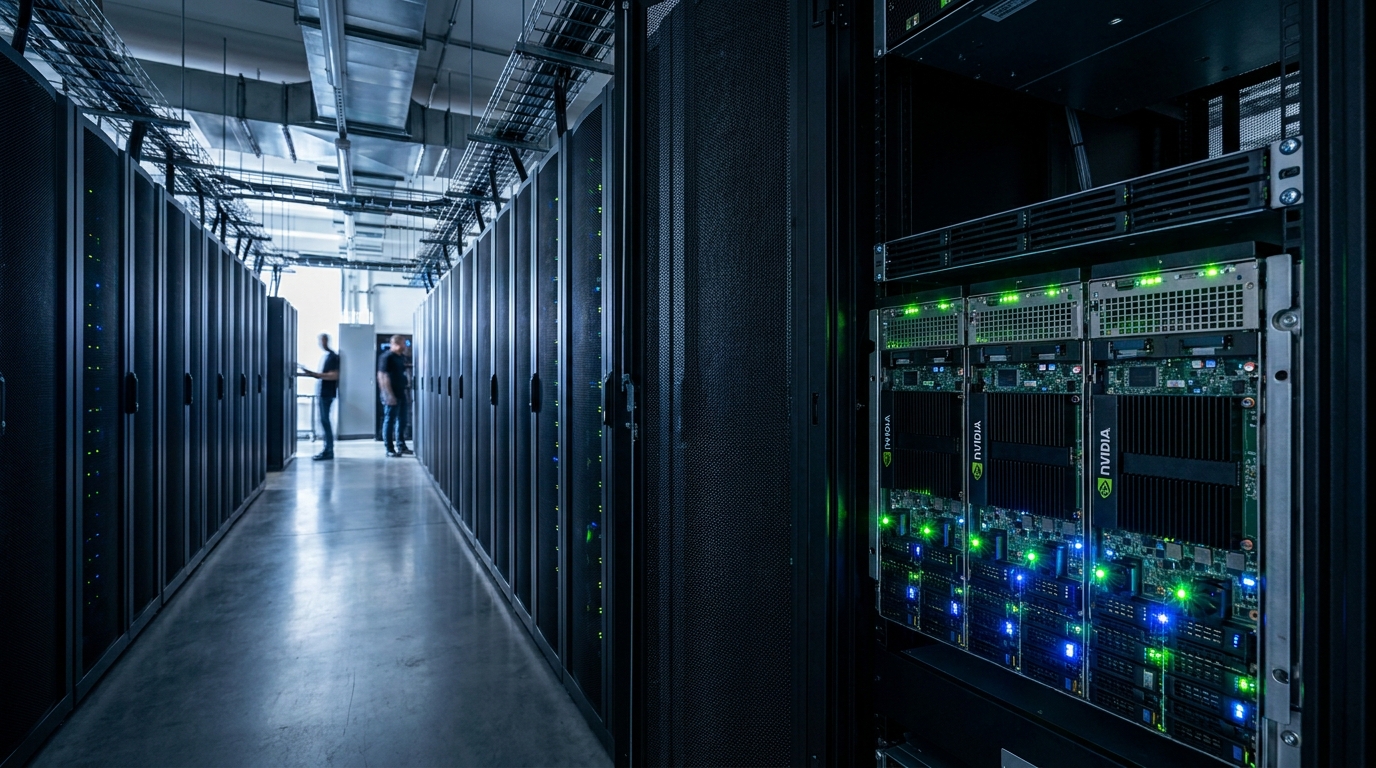
Advanced AI infrastructure matters when a platform needs to process large market datasets, train or evaluate complex models, simulate execution paths, and support continuous research workflows. NVIDIA describes the H100 platform as including fourth-generation Tensor Cores, a Transformer Engine with FP8 precision, NVLink, PCIe Gen5, and InfiniBand-oriented scaling for large AI and high-performance computing environments. NVIDIA H100 Tensor Core GPU.
For Zyra Capital, the credibility value is not simply naming the hardware. The credibility value is explaining what the infrastructure is for: market-data processing, model training, simulation, execution-quality research, and adaptive strategy evaluation.
The Trust Problem: Autonomy Needs Guardrails
AI agents in trading create a paradox. Users want speed and autonomy, but they also need control. The more autonomous a system becomes, the more important its risk controls become. Trust does not come from saying “AI decides.” Trust comes from explaining what the AI is allowed to do, what it is not allowed to do, and how the system behaves when something goes wrong.
What Users Should Look For in an AI Crypto Trading Platform
Clear explanation of the AI role: Does the platform explain whether AI is used for signal detection, risk scoring, execution routing, or user-interface automation?
Execution transparency: Does it explain how orders are routed, confirmed, and reconciled?
Risk controls: Are there exposure limits, venue controls, kill switches, and partial-fill procedures?
Infrastructure specificity: Does the platform describe the data, compute, network, and execution stack?
Realistic language: Does it avoid guaranteed profit claims and disclose risks clearly?
The Future: From Bots to Autonomous Market Systems
The next phase of crypto trading is likely to move beyond simple automation. Bots will still exist, but the more important category will be autonomous market systems: AI-supported infrastructure that can observe fragmented markets, evaluate opportunities, route execution, apply controls, and learn from outcomes.
That shift changes the standard for trust. The question is not “Does this platform use AI?” The question is “Does this platform have the infrastructure and discipline to let AI operate safely in a complex market?”
Frequently Asked Questions
What is the difference between an AI trading agent and a trading bot?
A trading bot usually automates predefined rules. An AI trading agent can evaluate context, use tools, respond to feedback, and coordinate multiple workflows within defined constraints.
Are AI trading agents risk-free?
No. AI trading agents can still face market risk, liquidity risk, execution risk, exchange risk, model risk, and technology risk. Autonomy should always operate inside risk controls and clear boundaries.
Why does execution infrastructure matter for AI trading?
AI signals only create value if the system can act on them effectively. Execution infrastructure handles routing, rate limits, fills, failures, and reconciliation across venues.
Why is crypto suitable for AI agents?
Crypto markets are digital, API-accessible, global, and fragmented. That structure creates both opportunity and complexity, making infrastructure quality especially important.
Does Zyra Capital guarantee trading profits?
No. No AI system, trading bot, or execution infrastructure can guarantee profits. Zyra Capital’s positioning should be understood as infrastructure and research-focused, not as a promise of investment performance.
Related Zyra Capital Research
The Execution Gap: How Zyra Capital Connects AI Trading Signals to 50+ Crypto Exchanges
Building AI Trading Infrastructure: NVIDIA H100 Training Architecture
AI-Powered Crypto Arbitrage with H100 GPUs and Reinforcement Learning
Sources and References
Disclaimer: This content is for informational purposes only and does not constitute financial, investment, legal, tax, or trading advice. Cryptocurrency and digital asset markets involve substantial risk, including possible loss of principal. Infrastructure design, AI systems, internal research, or historical examples do not guarantee future results. AI trading agents and automated execution systems may involve model risk, execution risk, liquidity risk, exchange risk, counterparty risk, cybersecurity risk, and technology risk. Zyra Capital provides software tools and research infrastructure and does not act as a broker, advisor, or investment manager.
更多来自 Insights 的内容

Crypto’s New Bull-Market Era: Bitcoin’s 2026–2028 Outlook and the AI Arbitrage Opportunity
Institutional demand, expanding financial infrastructure and Bitcoin’s approaching 2028 halving are creating a constructive foundation for the next crypto market expansion. Explore an optimistic, scenario-based Bitcoin outlook through 2028 and why greater liquidity, volatility and exchange activity could expand the opportunity set for Zyra Capital’s AI-driven arbitrage systems.

How Zyra Capital Protects Users: Security, Custody, Compliance, and Risk Controls
Zyra Capital explains its layered user-protection model across custody structure, security controls, SOC 2 security assurance, insurance arrangements, regulatory structure, risk disclosure, and responsible AI crypto trading infrastructure.
Building AI Trading Infrastructure: Inside Zyra Capital's NVIDIA H100 Training Architecture
In March 2025, Zyra Capital deployed production-grade AI training infrastructure built on NVIDIA H100 80GB GPUs and AMD EPYC 9754 128-core processors, enabling continuous model training across 50+ crypto exchanges with sub-20 ms latency.