

The Execution Gap: How Zyra Capital Connects AI Trading Signals to 50+ Crypto Exchanges
Zyra Capital explains the execution gap between AI trading signals and completed orders, including multi-exchange API abstraction, rate-limit handling, failure recovery, partial-fill controls, and March 2025 internal stress-test results across 50+ crypto venues.
At a Glance: The execution gap is the distance between detecting a trading opportunity and completing the required orders before the market changes. In AI-driven crypto arbitrage, that gap is often where theoretical edge disappears. Zyra Capital’s execution infrastructure is designed to reduce this gap through multi-exchange connectivity, API abstraction, routing controls, failure recovery, and continuous reconciliation across 50+ cryptocurrency venues.
Executive Summary
A trading model can identify an opportunity correctly and still fail if the execution layer is too slow, too brittle, or unable to recover from exchange-side errors. This article explains the engineering layer between AI signal generation and completed market action: order routing, exchange-specific API translation, rate-limit management, partial-fill handling, and post-trade reconciliation.
What Is the Execution Gap?
The execution gap is the operational space between signal detected and trade completed. A strategy may detect a price difference between two venues, but the opportunity only matters if the system can validate balances, account for fees and slippage, place the required orders, confirm fills, and reconcile positions before the spread closes.
In simple terms: the signal is not the trade. Execution is what determines whether a signal becomes a completed transaction or a missed opportunity.
Definition: The execution gap is the difference between identifying a trading opportunity and successfully completing the necessary market actions before latency, slippage, API failure, liquidity changes, or partial fills erase the opportunity.
Why the Gap Matters in Crypto Arbitrage
Crypto markets are fragmented across global exchanges. Prices, liquidity, funding rates, order-book depth, and trading fees vary by venue. Arbitrage strategies attempt to exploit those inefficiencies, but the execution window can be short. If one venue responds slowly, one order partially fills, or one API rejects a request, a theoretical spread can become operational risk.
A reliable multi-exchange execution system must coordinate several functions at once:
Market-data freshness: acting on current prices and depth rather than stale snapshots.
Pre-trade checks: confirming balances, fees, route viability, and risk limits before order placement.
Parallel execution: coordinating multiple legs across different venues.
Fill confirmation: verifying what actually happened instead of assuming an order completed.
Reconciliation: comparing internal state against exchange-reported balances and positions.
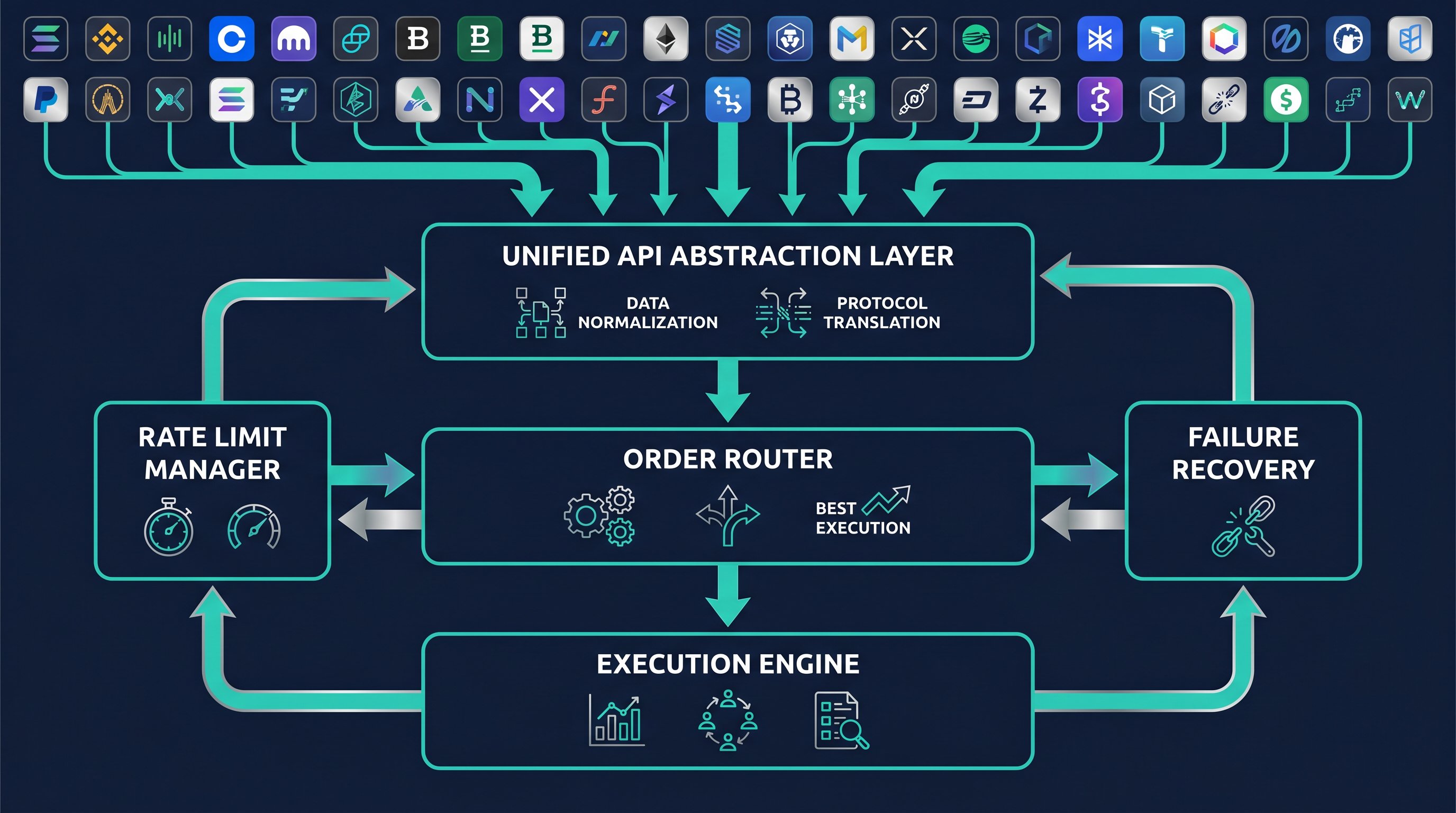
Why 50+ Exchanges Create Engineering Complexity
Connecting to one exchange is an integration project. Maintaining reliable execution across 50+ venues is a distributed-systems problem. Every exchange exposes a different API surface, authentication model, rate-limit policy, symbol format, order lifecycle, and error vocabulary.
Zyra Capital’s Execution Architecture
Zyra Capital separates strategy intent from exchange-specific implementation. AI models and strategy systems generate trading intent. The execution layer determines whether that intent is executable, how to route it, and how to confirm the outcome across connected venues.
The API Abstraction Layer
The exchange abstraction layer prevents trading strategies from becoming tangled with venue-specific API details. Strategies can express an internal intent, while the execution layer converts that intent into the correct exchange-specific request.
Order Translation
A unified order instruction must be translated into the correct venue format: symbol, side, quantity precision, order type, authentication signature, endpoint, and time-in-force rules. This keeps strategy design separate from exchange implementation details.
Rate-Limit Management
Rate limits directly affect execution quality. If a system exceeds exchange limits, order placement can be delayed, rejected, or temporarily blocked. Binance’s official Spot API documentation, for example, describes request-weight limits and HTTP 429 behavior for excessive requests: Binance Spot API rate-limit documentation.
Error Normalization
Different venues can report similar problems in different formats. A rate-limit error, insufficient-balance response, timestamp mismatch, or rejected order must be mapped into a common internal error model so the broader system can respond consistently.
Connection Health
Persistent connections can degrade without fully disconnecting. The execution layer therefore needs heartbeat checks, stale-connection detection, reconnect logic, and venue health scoring. Coinbase and Kraken documentation illustrate the breadth of venue-specific market-data and order-management workflows: Coinbase Advanced Trade API documentation and Kraken API documentation.
Failure Recovery and Position Reconciliation
Execution infrastructure is judged by how it behaves when conditions degrade. Multi-exchange trading must account for rejected orders, partial fills, stale connections, exchange downtime, latency spikes, and inconsistent balance reporting.
Circuit breakers: pause routing to degraded venues or affected strategy pairs.
Partial-fill controls: detect incomplete execution and trigger controlled recovery workflows.
Idempotent order handling: reduce the risk of duplicate orders during retry scenarios.
Dead-letter queues: preserve failed or ambiguous events for review and recovery.
Balance reconciliation: compare internal ledger state against exchange-reported positions.
Latency-aware routing: deprioritize venues whose response time makes a route unsuitable.
March 2025 Internal Validation Snapshot
In March 2025, Zyra Capital conducted internal validation of its execution infrastructure across 50+ exchange connections. The purpose was to evaluate system behavior under operational stress: connection stability, rate-limit handling, order-state tracking, partial-fill management, and recovery from degraded venue conditions.
Important: Internal validation describes system behavior under specific test conditions. It is not investment performance, not a profitability claim, and not a guarantee that future market or exchange conditions will behave similarly.
Zyra Capital Execution Layer vs. Typical Retail Bots
Most retail trading bots are built for convenience: connect an API key, choose a strategy, and automate order placement. Institutional-style execution infrastructure has a different objective: resilience under latency, failures, rate limits, partial fills, and multi-venue state complexity.
Why Execution Quality Changes Strategy Quality
Execution quality does not guarantee profit. It does, however, determine whether a strategy can survive real-world market structure. A model that assumes perfect fills, instant routing, and stable APIs may look strong in research but fail in production. A more realistic execution layer considers costs, depth, latency, rejection probability, and recovery paths before acting.
This is especially important for arbitrage because the strategy depends on narrow inefficiencies. The smaller the spread, the more important the execution layer becomes.
Execution Team and Operating Discipline
Zyra Capital’s execution work sits at the intersection of distributed systems, quantitative research, cybersecurity, capital allocation, and operational controls. The team structure matters because execution quality is not only a code problem; it is a systems-design and risk-management discipline.
Jeremy Campbell — Founding Execution Systems Engineer. Focuses on order routing, exchange adapters, failure recovery, and execution-state control. LinkedIn
Irene Fedier — Co-Founder and Managing Director. Oversees strategic direction, operating discipline, and cross-functional alignment. LinkedIn
Jodesio Michaels — Co-Founder and CTO. Leads infrastructure architecture and technical systems design. LinkedIn
Timothy C. Bachmann — CAIO. Bridges AI research, allocation logic, and infrastructure requirements. LinkedIn
Learn more about the broader company and leadership team on the Zyra Capital About page.
Frequently Asked Questions
What is the execution gap in crypto trading?
The execution gap is the difference between detecting a trading opportunity and successfully completing the necessary orders before the opportunity changes or disappears.
Why is multi-exchange execution difficult?
Each exchange has different APIs, authentication rules, rate limits, order types, symbol formats, precision requirements, latency patterns, and error responses. Coordinating execution across many venues requires specialized infrastructure.
What is an exchange API abstraction layer?
An API abstraction layer converts one internal trading instruction format into the specific API calls required by each exchange. It keeps strategy logic separate from exchange-specific implementation details.
Why do rate limits matter for arbitrage?
Rate limits can delay or reject requests. In time-sensitive arbitrage, a delayed order can mean the spread disappears before execution completes.
What happens if one leg of an arbitrage trade fills but the other does not?
The system must detect the mismatch, pause affected routes if necessary, reconcile positions, and either hedge or rebalance according to risk controls. Partial fills are one of the core risks of multi-exchange execution.
Does better execution guarantee profit?
No. Execution infrastructure can reduce certain operational frictions, but it cannot eliminate market risk, liquidity risk, counterparty risk, technology risk, or model risk. No trading system can guarantee profit.
Related Zyra Capital Research
AI-Powered Crypto Arbitrage with H100 GPUs and Reinforcement Learning
Building AI Trading Infrastructure: NVIDIA H100 Training Architecture
Sources and References
Disclaimer: This content is for informational purposes only and does not constitute financial, investment, legal, tax, or trading advice. Cryptocurrency and digital asset markets involve substantial risk, including possible loss of principal. Infrastructure design, internal testing, or historical examples do not guarantee future results. Arbitrage is not risk-free and may involve liquidity risk, execution risk, exchange risk, counterparty risk, and technology risk. Zyra Capital provides software tools and research infrastructure and does not act as a broker, advisor, or investment manager.
Mehr aus Insights

Crypto’s New Bull-Market Era: Bitcoin’s 2026–2028 Outlook and the AI Arbitrage Opportunity
Institutional demand, expanding financial infrastructure and Bitcoin’s approaching 2028 halving are creating a constructive foundation for the next crypto market expansion. Explore an optimistic, scenario-based Bitcoin outlook through 2028 and why greater liquidity, volatility and exchange activity could expand the opportunity set for Zyra Capital’s AI-driven arbitrage systems.

How Zyra Capital Protects Users: Security, Custody, Compliance, and Risk Controls
Zyra Capital explains its layered user-protection model across custody structure, security controls, SOC 2 security assurance, insurance arrangements, regulatory structure, risk disclosure, and responsible AI crypto trading infrastructure.

AI Agents vs Trading Bots: Why Crypto Trading’s Next Era Depends on Execution Infrastructure
AI agents are changing the crypto trading narrative, but trust depends on more than automation. Zyra Capital explains why execution infrastructure, risk controls, multi-exchange routing, and reconciliation matter more than another trading bot.